
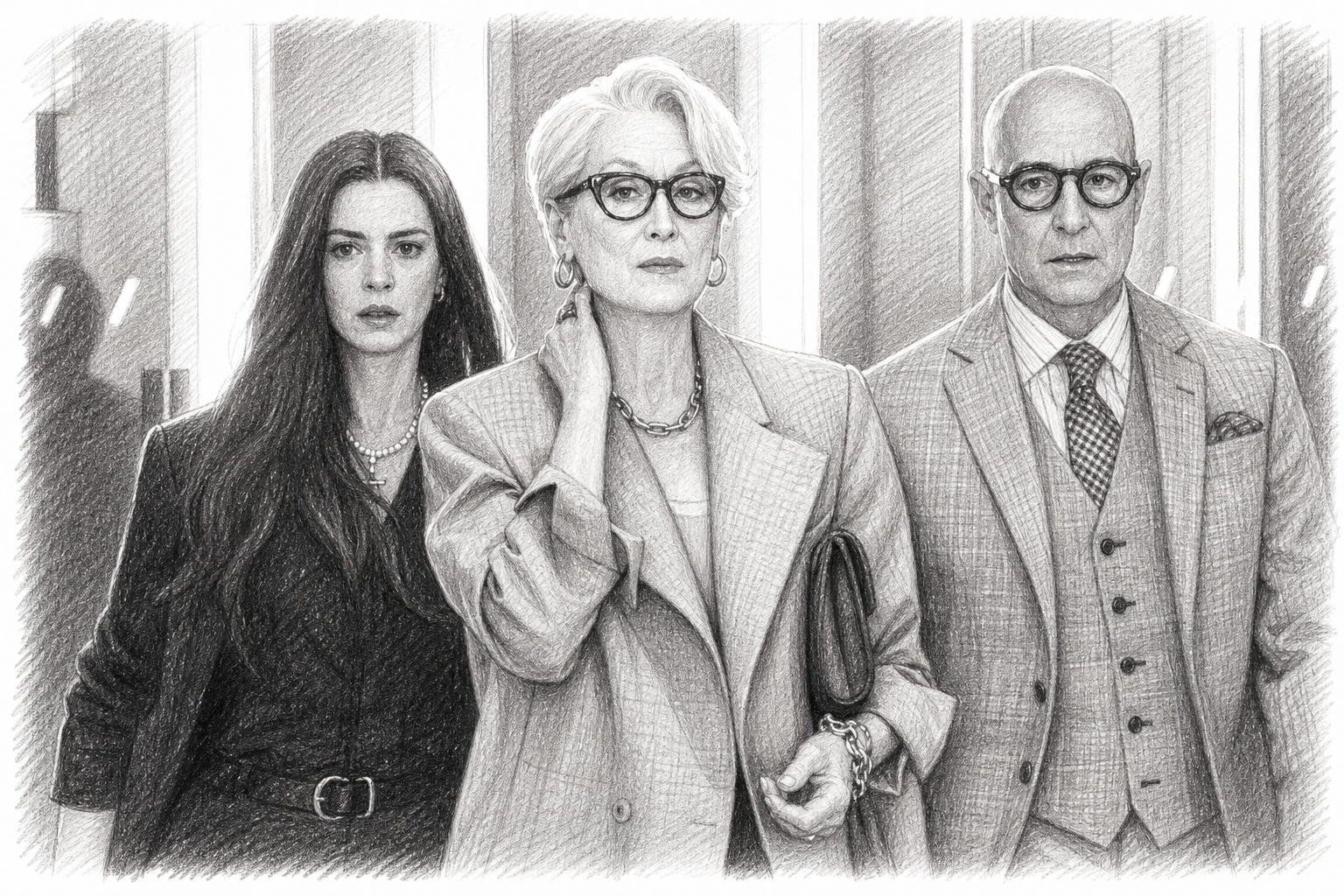
"The Devil Wears Prada 2" Review
OP-ROB RATING: BENCH
2006’s “The Devil Wears Prada” is a bona fide “rewatchable” movie. It’s the kind where if you are flipping channels and DWP is on, you’re likely going to stick around, no matter where you are in the run time. So what makes DWP imminently rewatchable? I think there are four major factors:
Number one: Shiny New York City
This is not the New York City of “Uncut Gems” or “After Hours”. It has a clean, sparkly, and peppy veneer. It’s unrealistic, but engaging and gleeful. The soundtrack adds to the fantasy appeal. DWP’s opening scene encapsulates this perfectly: beautiful people getting dressed in beautiful clothes within beautiful apartments before emerging into the sunny and beautiful bustle of the city, all to the tune of KT Tunstall’s energetic hit, “Suddenly I See”.
Number two: The Novelty
I suppose there is some variation here depending on your background, but for most people, and especially guys, the world of high fashion is a mystery. DWP throws you into a glamorous, ambitious, and ferociously appealing industry. This experience is enhanced because the central character Andy Sachs (Anne Hathaway) is in the same boat as most of us. We get immersed just as Andy does; everything is fresh.
Number three: Andy’s Everyman Status
This is tied to the previous factor. Many of the most enjoyable scenes in DWP involve Andy’s reaction to the ridiculousness of Runway. I immediately think about the belt scene in the costume room, in which an assistant holds up two nearly identical (to the common man) turquoise belts and says “they’re so different”. Andy scoffs, and we scoff alongside her.
Number four: The Wrath of Miranda Priestly (Meryl Streep)
This factor is the most important. Miranda's vitriol propels the film. She's unreasonable, icy, and brimming with venom. A flurry of jacket throws, coffee orders, Smith & Wollensky and Harry Potter manuscript taskers; she's unhinged. It's awesome. And that unbelievable level of abuse is undergirded by a serene and calculated confidence. I again think about the belt scene, which leads into the pitch perfect “cerulean monologue” in which Miranda completely disarms and humiliates Andy. Miranda is fairly evil. And her villainy makes any glimpse of humanity incredibly effective, particularly the scene in which we see her marriage failing.
20 years later, we get “The Devil Wears Prada 2”, and it hits on one, just one, of my factors. The veneer is still there. We are indeed welcomed back to fantasy land NYC accompanied by a glitzy soundtrack helmed by Lady Gaga. But the other three? Totally absent. Two and three cannot be helped. This is the second dip, and novelty wears off. And then Andy is also back for round two in the fashion world. She knows the ropes. Everyman no more.
And then number four. In DWP2 Miranda has been completely defanged. It's pitiful. Some of this is built into the story. HR complaints have forced her to hang up her own jacket. Her primary assistant keeps her comments in check (i.e. no denigrating comments about plus size models). So much of what made the first installment great was Miranda’s workplace terrorism. We get basically none of that in DWP2. Even the most likely targets are left alone. For example, her secondary assistant is a grossly overweight guy. Crickets. Miranda is restrained, and therefore the entire movie is restrained.
What else can be said? The storyline is fine I suppose. Runway (and therefore Miranda) faces an existential threat of extinction due to the decline of print media, as well as a very present threat due to a breaking news story that reveals a Runway promotion of a fast fashion brand that uses child labor. Andy, now an experienced yet freshly unemployed journalist, is brought onboard to revamp Runway's image. All goes well until the owner of Elias-Clarke Publications (the company that owns Runway) suddenly dies and his corporate-bro son (portrayed by B.J. Novak), takes over. Consultants and cost cuts ensue, and the rest of the movie is about Runway's path to survival. Emily Blunt and Stanley Tucci return as Emily Charlton and Nigel Kipling, respectively. Both are great actors, and they figure heavily into the plot. Overall, it’s serviceable, if not extraordinary.
Aye, but the clever plot is not enough. DWP2 makes the fatal mistake of attempting to deliver a few moral lessons: the importance of journalism, the evils of McKinsey and like-minded consultancies, and the necessity of female empowerment. Yeah, yeah, yeah. Give us a break. This is the world of high fashion. It's in the “S tier” of infertile ground for moral posturing. Don't bother. Take the initial plot device about Runway’s child labor fiasco. What’s the solution? Hire a crack journalist to write a mea culpa and puff up the magazine’s image. How brave and noble! Seriously, it’s not worth it. Maybe only if we can get a “The Devil Wears Prada 3: Runway partners with The Equalizer to liberate the sweatshop workers”.
On to the categories…
Highlight of the Game: Pick a scene with Stanley Tucci, I guess? Or perhaps Emily’s reintroduction? There is not a world-shattering moment like the “cerulean monologue” this time around.
Player of the Game: Stanley Tucci is an incredible actor. And unlike Meryl Streep in DWP2, his character has not been soul-drained. Tucci’s Nigel Kipling anchors most of the emotionally compelling scenes in DWP2, just like in the first installment.
Costly Turnovers: The above review is mostly negative, and covers the most glaring issues. One additional nitpick would be the failure of DWP2 to make effective use of its cameos. High-profile athletes like Rory McIlroy and Karl-Anthony Towns make appearances. Pop icon Lady Gaga also has a scene. All are flops, with zero effort to work in some kind of quippy dialogue to make the celebrity pop-ins remotely memorable.