OP-ROB

Film and Television Reviews

  • Updates
  • Reviews
  • Rating System
  • About
  • Op-Rob Top 50

"Miles Ahead" Review

April 27, 2016 by Robert Doughty

OP-ROB RATING: STARTER

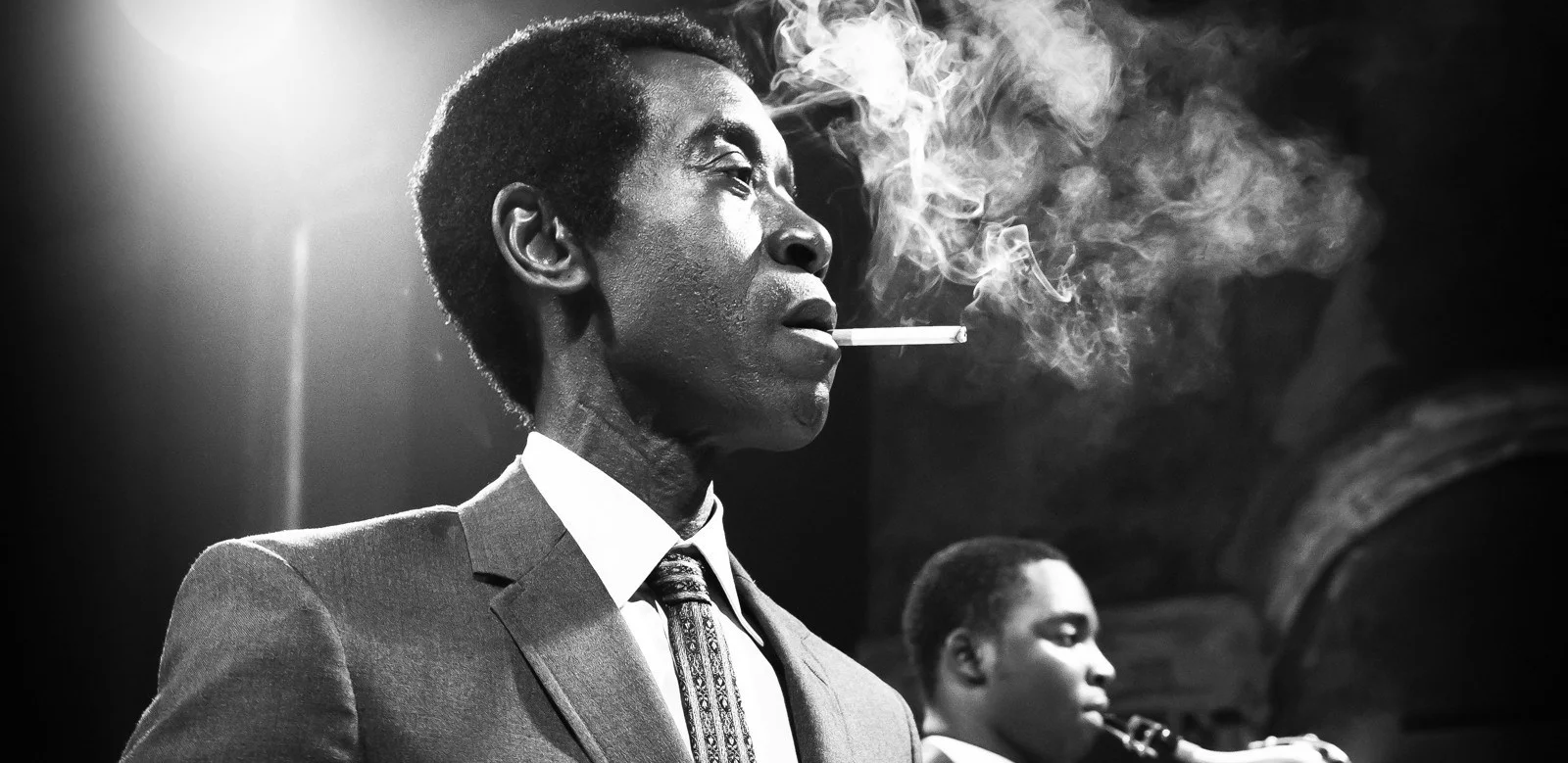
            “Miles Ahead” is a film about the Jazz musician Miles Davis directed by Don Cheadle and starring Don Cheadle as Miles.  The basic premise of the film revolves around an encounter between Miles and a nosy reporter named Dave Braden (Ewan McGregor).  Set in the 1970s, Miles is living in his New York City home as a recluse and cocaine addict, refusing to produce any new music.  Braden manages to break into Miles’ house insisting on an interview and is promptly socked in the face by the Prince of Darkness. Infuriated by the invasion of privacy, Miles travels to Columbia Records with a gun in order to lambast his producers. It is in the studio headquarters where Miles is introduced to a jazz musician named Junior (Keith Stanfield) and his sleazy agent, Harper Hamilton (Michael Stuhlbarg).  Miles promptly leaves the studio when Braden promises to score them some quality cocaine.  During a house party at Miles’ later that night, Junior and Hamilton steal a new recording from a drawer in the house. Through a series of events, Miles and Braden end up as a kind of tag team to retrieve the stolen recording.  Throughout the adventure they encounter a series of obstacles and run into various amusing situations.         

What separates “Miles Ahead” from an average biopic is the way in which Cheadle directs and tells the story through two distinct lenses: the mythic Miles and the factual Miles.  There are essentially two storylines, one that is strung together throughout the film on a consistent timeline and another that is delivered in intermittent flashbacks.  The flashbacks typically reveal an event in Miles’ life that really occurred:  moments in studios making the music that defined an era of jazz, scenes of tumult with his wife, and the infamous the assault outside the Birdland music venue in 1959.  Cheadle’s cuts to the past are always creative, and usually flow from what is going on in the 1970’s storyline.  In one scene Miles is holding a punching bag and encouraging Braden to take lick at it.  One of Braden’s punches cuts into a flashback.  The most interesting technique Cheadle employs occurs after Miles has an emotional conversation on the phone with girlfriend Frances (Emayatzy Corinealdi) in which he asks her to marry him.  After Miles sets down the phone he returns to a bed occupied by two nude women.  As Miles climbs back in with the women the camera moves over a series of Polaroids scattered around the bed depicting the sex fueled night.  Without a cut, photos of Miles and Frances’ ensuing wedding enter the lineup and the scene leads into the actual wedding day.  It is an unconventional and telling sequence depicting Miles’ double life.

The fictional adventure involving the stolen record plays out much like a light and engaging heist flick.  The flashback driven, realistic storyline in "Miles Ahead" often gives meaning to the overarching fictional one and brings the biopic together.  Scenes of Miles’ turbulent marriage and wild sex life depict the many facts that comprise this unbelievable personality that is portrayed in the fictional story.  The assault outside of Birdland helps explain why the mythic Miles is so abrasive towards white people.[1]  While the flashbacks do provide many hints that characterize mythic Miles, they certainly don’t tell the whole story.  For viewers unfamiliar with Davis' life, there will be a significant disconnect between the two storylines.  Those uninformed won't realize that Davis sees himself in Junior, who is a struggling trumpeter and heroin addict. This relationship is subtle, and can only be accessed with the knowledge that Davis was heavily addicted to heroin himself in the early 1950s.  

Cheadle’s performance as Miles is terrific; he nails the raspy voice and mercurial flare of the late musician.  Although this film is not catered to a wide audience, it is clear that Cheadle himself is a Miles Davis aficionado, and wanted the film to be for similar fans.  In one scene Miles listens to a man on radio proclaim his record Kind of Blue a “masterpiece”.  Hearing this, Miles phones into the radio station declaring the record a “miss”.  Miles Davis understood what people wanted from him.  He knew what was popular, i.e. Kind Of Blue.  But Davis didn't want to be popular; he wanted to push the limits of those people who thought they knew his music.  In many ways, a Miles Davis biopic could be crafted without much innovation in terms of the actual storyline.  Get a good director, a good lead actor, a good screenwriter, and the product wouldn’t look too shabby.  However, as a Miles Davis admirer, Cheadle takes a lot of risks by going on an unconventional route with a fragmented storyline and a completely fictional cover story.  Amazingly, the risks pay off.  The film is quirky, entertaining, well directed, and always unpredictable.  “Miles Ahead” is a fitting tribute to its larger-than-life subject.


[1] One of my favorite Miles quotes left out of the film is, “it’s like, how did Columbus discover America when the Indians were already here? What kind of shit is that, but white people’s shit?”  An actual quote from Miles Davis, it reveals the kind of biting wit and attitude that is infused in the mythic Miles portrayed by Cheadle.
April 27, 2016 /Robert Doughty
1 Comment

"The Jungle Book" Review

April 18, 2016 by Robert Doughty

OP-ROB RATING: STARTER

“The Jungle Book” is a children’s adventure film directed by Jon Favreau. Personally, Favreau always brings to mind D-Bob, the loyal best friend he portrayed in the Notre Dame football gem “Rudy” which came out in 1993.  However, in recent years Favreau has become one of the most touted directors in Hollywood, and deservedly so. He has directed“Elf”, “Iron Man”, “Iron Man 2”, “Cowboys & Aliens” and “Chef” as well as a few others.  Favreau’s “The Jungle Book” is an adaption from both Rudyard Kipling’s book as well as the 1967 animated film that many people know so well.  The main character in the film is Mowgli (Neel Sethi), a boy who has grown up in the jungle raised in a pack of wolves led by Akela (Giancarlo Esposito) who is strict, but just.  Under the tutelage of both Akela and a black panther named Bagheera (Ben Kingsley) Mowgli does his best to live as a wolf, learning their hunting tactics and their oath “The Law of the Jungle”.  However, Mowgli is forced to leave the pack when he is threatened by a tiger named Shere Khan (Idris Elba), who holds a grudge against all humanity for an altercation that left him burnt and blinded in one eye.  Bagheera volunteers to bring Mowgli to a nearby “man-village”, because that is where a “man-cub” belongs.  On their way out, Shere Khan attempts to kill Mowgli and is thwarted, but the failed attack leaves the man-cub and Bagheera separated.  On his journey, Mowgli meets various animals including a devious snake named Kaa (Scarlett Johansson), a Himalayan brown bear named Baloo (Bill Murray), and a power-hungry Gigantopithecus ape named King Louie (Christopher Walken).

The live action aspect of this remake is precisely what allows it to expand into a full-length feature film.  The 1967 Disney original was mostly a series of songs and outrageous comedy sequences that ran for a mere 78 minutes.  Favrea’s “Jungle Book” is a 105-minute adventure with a fully fleshed out story.  For a PG rated kids movie Favreau’s “The Jungle Book” is also surprisingly gritty.  The jungle is not a colorful fantasyland; in fact it is often harsh and unforgiving.  In one scene Mowgli stands in a muddy ravine dodging a stampede of water buffaloes.  All of the fighting sequences are brutal.  The animals grapple and slash at each other.  Shere Khan’s abrupt assassination of Akela involving a swift chomp to the neck must have shocked many of the youngsters sitting in the theater.  Although most of the animals can talk, there is not much else that is tame about this jungle.

The best aspect of “The Jungle Book” is the voice cast.  There is not a poor showing from any of the actors and actresses involved in bringing the animals to life.  Both Kingsley and Elba bring their characters Bagheera and Shere Khan a level of elegance absent from the original film.  Murray, as always, is absolutely charming in the role of Baloo.  The scenes with the witty brown bear are the most fun to watch.  Who would be better than Murray to portray the “fun uncle” mentor for Mowgli? 

Despite powerful voices the live-action aspect of the film works against itself in the expressions of the animals.  There is one particular scene in which Shere Khan speaks with Akela regarding Mowgli’s departure.  Akela stands upright looking into the distance while Shere Khan lounges on a rock below him.  They do not make eye contact and speak with one another in a serious tone.  Yet, if you were to mute the scene it could easily be mistaken as a live shot of animal planet or a scene at a zoo.  These animals can talk but their faces often say nothing.  Perhaps more attention could have been paid to the eyes and the mouths of the animals during production, because this is an area in which the original film excelled.

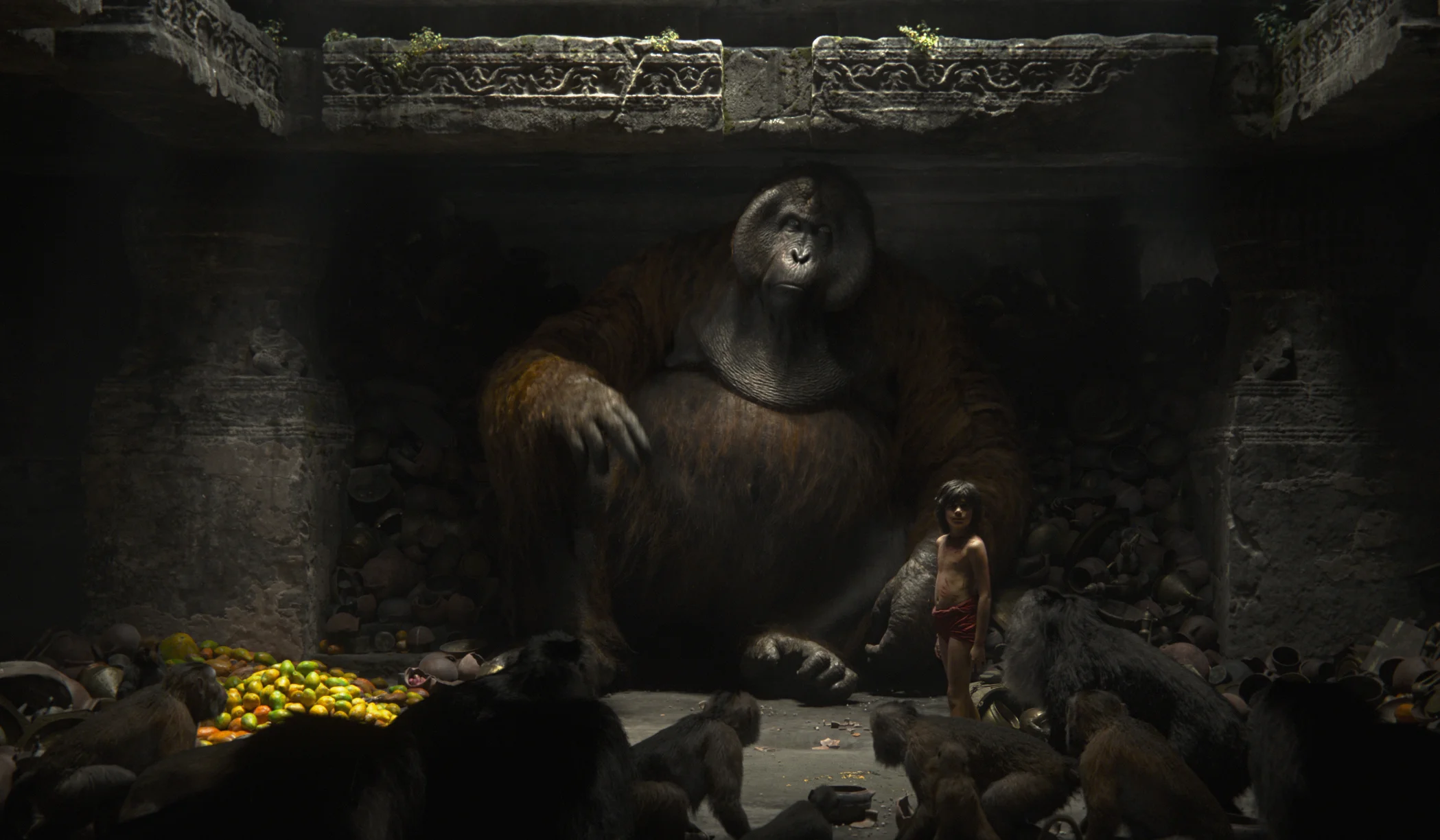
Another deficiency in “The Jungle Book” is the blatant shifts in tone throughout the movie. Although Favreau’s realistic approach is enthralling and original, it conflicts with the lighthearted aspects of the 1967 film that he incorporates.  One scene will be light and happy, and the next will be dark and intense. The “I Wan'na Be like You” scene with King Louie is the best example of this strange dynamic.  Having been kidnapped by monkeys and confronted King Louie, Mowgli is in a very real and very scary situation.  Christopher Walken is as creepy as ever voicing the massive ape.  However, when Louie breaks into song the scene is drained of all suspense.  Paying homage to the original is undoubtedly important, yet Favreau’s new take on the story and the colorful musicality of the first film often do not mix.

The standout weak link of “The Jungle Book” is Neel Sethi’s performance.  Mowgli is an innately likeable character and somehow Sethi manages to make him annoying.  Perhaps it is a lack of poise in his voice compared to the likes of Kingsley, Murray, Elba, and Johansson.  No matter the situation Sethi always seems to be yelling, speaking out of exasperation.  A scene in which this occurs is when he and Bagheera are walking toward the man-village in the beginning of the movie.  Mowgli pleads to Bagheera not by genuinely having a discussion but by complaining like a spoiled brat.  His reaction to the news of Akela’s murder is equally poor in its delivery, “You knew, you both knew!” he screams at Bagheera and Baloo.  Sethi reminded me a lot of Jake Lloyd as Anakin Skywalker in “Star Wars: The Phantom Menace”, everything he says is a kind of over dramatization.  “The Jungle Book” features a single human; a solid performance from this individual is a simple bare necessity.

Overall “The Jungle Book” is too good in certain areas to condemn for its inconsistencies.  In time, the movie will prove durable amongst the younger crowd.  Perhaps one day kids will remember this “Jungle Book” like so many other adults remember the animated version. 


OP-ROB NOTE: There is a great reference in the form of a cowbell. Keep an eye out for it.

April 18, 2016 /Robert Doughty
2 Comments

"Hardcore Henry" Review

April 09, 2016 by Robert Doughty

OP-ROB RATING: BUST

“Hardcore Henry” is an action film directed by Ilya Naishuller that was entirely shot using a GoPro camera. From start to finish it is in first-person point of view, much like a video game. The main character is Henry, a man living in the future who awakens in a hovering medical laboratory and with an arm and a leg missing. Estelle, (Haley Bennett) a woman dressed in a white lab coat, proceeds to attach Henry’s missing limbs with mechanical replacements. While Estelle works on Henry, she explains that he has amnesia due to the accident that resulted in his injuries. She also explains that they are husband and wife, even though he cannot remember. Estelle leads Henry into a separate room in the laboratory where his “speech module” is to be installed. However, as the technicians prepare to give the main character a voice, a group of heavily armed soldiers break into the lab and kill everyone with the exception of Henry and Estelle. These men are led by Akan (Danila Kozlovsky), a telekinetic, sociopath who maliciously wants to steal Henry’s technology in order to create his own army of super soldiers. In the commotion, Henry and Estelle escape the lab in an escape pod, that crash lands on a busy freeway below. However Akan and his soldiers soon catch up with the couple and Henry is blasted off of the freeway after being shot by a taser. This leaves Henry separated from Estelle and on the run from Akan and his soldiers.

“Hardcore Henry” has minimal plot, minimal character development, and minimal believability. However, in the case of this film none of those shortcomings matter.  The POV filming technique and non-stop action are supposed to be enough. “Hardcore Henry” is a one trick pony through and through. While the POV filming compliments some scenes well, for the most part it acts as a negative, making simple scenes annoying and even unbearable to watch.  For instance, when Henry grapples with a mercenary in a one-on-one melee, the POV works fantastically. In the skirmish Henry punches and grabs at the man who is suddenly shot by a sniper, and his head explodes right in front of the audience. It’s a shocking sequence made even more effective by the POV. On the other hand, the film is full of chase sequences that are enough to give anyone a headache. The cuts are choppy as Henry runs from point A to point B jumping over stuff and occasionally falling down. The constant shaking drains from the environment in which the story takes place. A film technique designed to put the viewer in the shoes of the subject does exactly the opposite in these frantic sequences. Henry is running and fighting for the majority of the movie, and this makes it very hard to get a grip on any particular setting. Some viewers may find the POV more agreeable than others, but there is no denying that is robs the viewer of a concrete and omniscient eye.

“Hardcore Henry” is also too hard-core for its own good. There is a numbing effect to the violent action and loud noises. If you received a nickel for every bone Henry breaks throughout the movie you would easily refund your ticket. Aside form hand-to-hand combat; there is an abundance of explosions and almost non-stop gunfire. By the end of the film, Naishuller has to resort to pure absurdity to illicit a fitting grand finale. The last fifteen minutes of “Hardcore Henry” are so over-the-top, it proves nothing except for Naishuller’s lack of craft and judicious use of violence in his film. A great director can make your ears ring for days with a single, well placed gunshot. Anyone who saw “10 Cloverfield Lane” would know.

Lost in the scuffle of “Hardcore Henry” is an entertaining performance delivered by Sharlto Copley as Henry’s ubiquitous fighting partner and advocate, Jimmy. Most of the time Jimmy gives Henry information and saves him from various situation, each time reappearing as a new version of himself ranging from a Russian homeless man to a Michael Jackson enthusiast. Copley is lively and refreshing whenever he shows up, yet his sporadic appearances often feel wasted when the action starts up again.

However, one could argue that “Hardcore Henry” serves its purpose, and stays true to the one trick of POV action. Perhaps the film is supposed to be excessive and unrelenting in its ferocity. Even in this aim, “Hardcore Henry” pales in contrast to films that have followed the same formula. Director Gareth Evans’ “The Raid: Redemption” and “The Raid 2: Berendal” are both similar to “Hardcore Henry” in that they are driven by action. Storyline and character development get tossed in the process. Unlike Henry, Evans’ characters fight using martial arts techniques that are a marvel to watch.  “Hardcore Henry” is brutish in comparison. Most of the time Henry shoots his enemies, and on occasion rips their hands apart gripping their fingers like two ends of a wishbone.

Ultimately, “Hardcore Henry” doesn’t put enough support around its POV focus to make a worthwhile full-length feature film. The trailer is far more enjoyable than the hour and a half slog. Seeing one fight sequence in “Hardcore Henry” is to see them all.  For some people, the action may be enough to entertain, but this film is as voiceless and forgettable as its main character.


April 09, 2016 /Robert Doughty
Comment

"10 Cloverfield Lane" Review

March 11, 2016 by Robert Doughty

OP-ROB RATING: ALL-STAR

Remember the movie “Cloverfield” that came out in 2008? It was about an alien attack on New York City and the entire movie was supposed to look as if it were filmed on a handheld camera. Fast-forward nearly a decade and “Cloverfield” has given birth to a sequel called “10 Cloverfield Lane”. Both films involve science fiction, and both were produced by J.J. Abrams. However, “10 Cloverfield Lane” is a much different movie in almost every other respect. It stars Mary Elizabeth Winstead as Michelle, a woman who flees her fiancée after a fight and ends up in a horrific car accident. She is run off the road by a pickup truck and awakens in a concrete walled room where she is chained up.  An obese, rugged looking man (John Goodman) greets her by vaguely explaining that there has been an attack on earth and that he saved her from the car accident and brought her to his underground bunker. Michelle reacts as any normal person would after being abducted, but the man shrugs off her anxiety and frustratingly tells her “You need to eat. You need to sleep. And you need to show me a little bit of appreciation”.  After the sketchy conversation he finally introduces himself adding, “My name’s Howard by the way”.

After being unchained, Michelle meets Emmet (John Gallagher, Jr.), a young man who helped build the bunker for Howard. Unlike Michelle, Emmet forced his way into the bunker after the first signs of the attack, which he describes as an unnatural bright red flash. Howard reiterates over and over the dangers of going outside the bunker. A lifelong conspiracy theorist, he believes the attack could be alien and must have resulted in some kind of fallout or air contamination. The single window at the entrance to the bunker reveals two dead pigs that have been chemically burned almost beyond recognition. Despite Emmet’s testimony and the dead pigs, Michelle remains skeptical of the entire situation. And now we’ve reached spoiler territory, so I will back off. But in any case, as the evidence piles up Michelle must decide what to believe is the truth. It is her life that depends on it.

 For the record, I didn't enjoy the first Cloverfield movie. The concept was cool, but the shaky camera took away from the suspense and blurred any special details the movie had to offer. A great thriller thrives on the little things like subtleties in dialogue or seemingly unimportant objects in a room that come together to tell more of the story or provide some kind of shocking revelation. “10 Cloverfield Lane” is certainly detail minded. Most of the movie takes place in Howard’s bunker, which consists of four or five rooms. What a man chooses to put in his survival chamber says a lot about him.

Howard is an especially interesting character. He has all the stereotypes associated with a longtime conspiracy theorist, such as loads of nuclear fallout books and pamphlets as well as a military background. Although Howard projects himself as a “man with a plan”, he is always somewhat anxious about every situation. His desire for control is the kind that cannot be satisfied with other human beings around. In one scene the three are playing a board game that resembles “Catch Phrase”. Emmett is holding a card for "Little Women", and prompts Howard by pointing at Michelle to queue "woman". Howard can't seem to find the word, saying stuff like "little girl" and "little princess". Apparently "woman" is not in his vocabulary and he fails the round. It is an enthralling and strange scene that could suggest any number of things about Howard that I am still trying to figure out. It is scenes like this one that complicate the characters and elevate "10 Cloverfield Lane" above your average series of thrills.

Although both Goodman and Gallagher, Jr. deliver excellent performances, Mary Elizabeth Winstead is the most impressive in the role of Michelle. Far from your average "scream queen" she is resilient, resourceful, and fiercely determined to discover the truth. In many horror/thriller movies, the protagonist does stupid stuff all the time. Like going into the empty house or looking around the sketchy corner to investigate a strange noise. Michelle rises above these annoying faults and it is refreshing to watch. Throughout the story she never believes anything that the audience wouldn’t and reacts to perilous situations with the efficiency of Jason Bourne (Matt Damon).

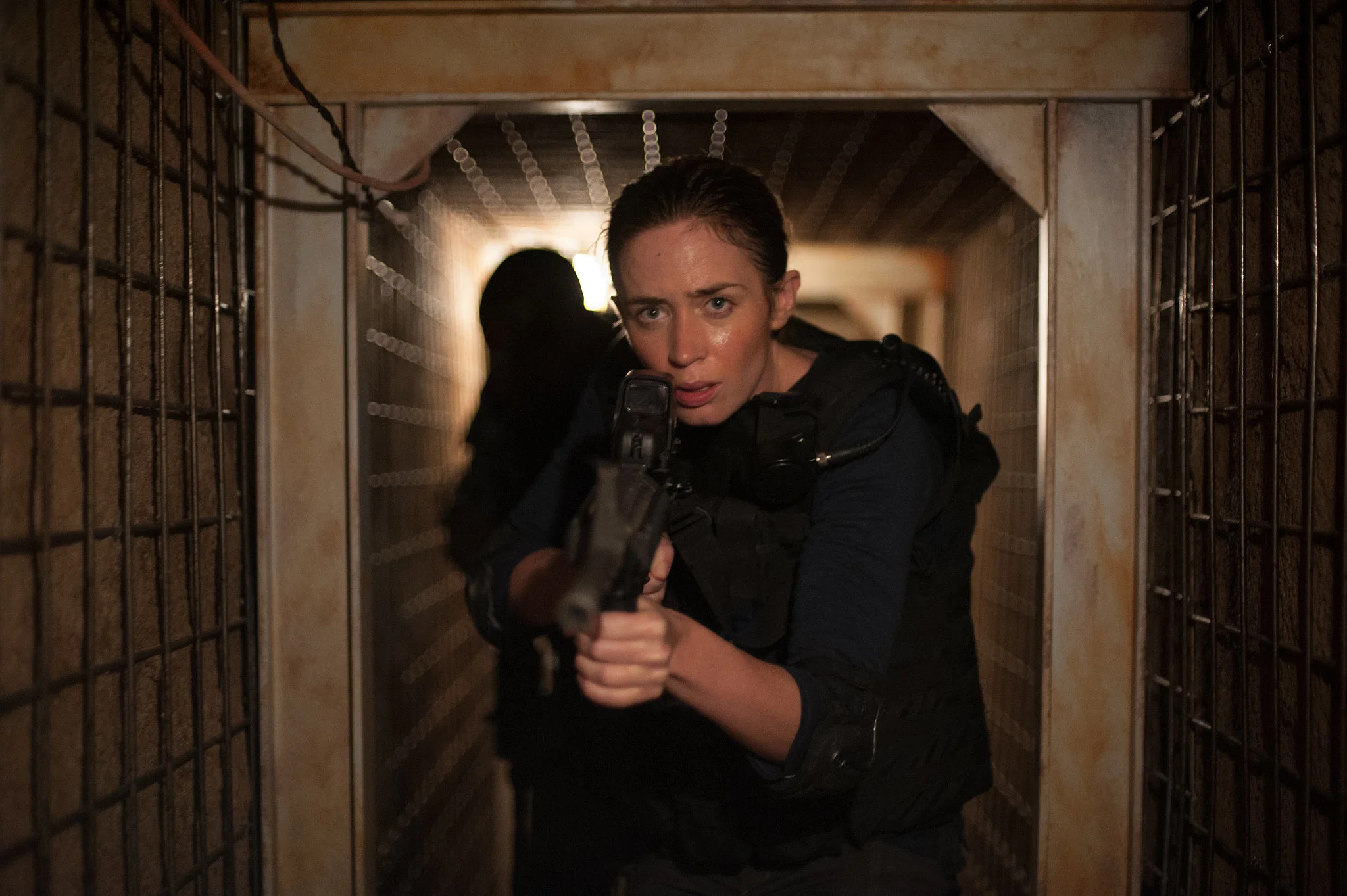
          Perhaps the most effective aspect of “10 Cloverfield Lane” is its use of sound. The movie is relatively quiet most of the time. There are a few songs played on the jukebox and some light rumblings outside the bunker. It is the judicious use of loud noises that make the slamming of door, the banging of a table, or the discharge of a gun sound so loud and so shocking. A movie I reviewed last year called “Sicario” starring Emily Blunt shared the same mastery of suspense through sound. The loud noises are crucial to the thrills in “10 Cloverfield Lane” and they don’t disappoint. While the final act of the movie was somewhat dissatisfying, “10 Cloverfield Lane” defies your typical sequel and results in an innovative and entertaining thriller.


OP-ROB NOTE: The actor who plays Emmet, John Gallagher, Jr., is also in a movie called "Short Term 12" starring Brie Larson. It's on Netflix if you get bored and need something awesome to watch.


March 11, 2016 /Robert Doughty
Comment

"Zootopia" Review

March 05, 2016 by Robert Doughty

OP-ROB RATING: ALL-STAR

“Zootopia” is about an ambitious young bunny named Judy Hopps (Ginnifer Goodwin), who lives in a modern society where animals all get along, predator and prey alike. Despite the pleas of her protective parents, Judy ditches the idea of becoming a carrot farmer and pursues a career as a police officer. She overcomes all adversity and graduates the police academy at the top of her class to become the first police bunny ever. Upon graduation, Judy is sent to Precinct 1 located in the heart of the great city of Zootopia. Judy’s parents caution her to be wary of predators like lions and tigers and bears, but especially of foxes. As Judy’s parents see it, despite how far society has come in the world of “Zootopia”, some animals will always revert back to their “savage” ways. Judy reluctantly accepts the anti-fox mace spray her parents give her and hops on the train to the big city.

Zootopia is nothing short of a grand metropolis with gleaming buildings and distinct neighborhoods. Just a few include the “Rainforest District”, “Sahara Square”, and “Tundratown”. Judy is stationed in the downtown area where she is rudely greeted by her superior officer, an Ox named Bogo (Idris Elba). Judy the bunny looks out of place in a room full of tougher animals such as Timberwolves, Cheetahs, Lions, and Rhinos. Bogo addresses the room about fourteen missing persons from around Zootopia and promptly assigns all of the tough animals to the separate cases. He sticks Judy on parking duty, making her nothing more than a “meter maid”. Through a series of events, Judy is allowed to investigate a case regarding a missing otter named Emmett Otterton. Her lead witness in the otter’s disappearance is a clever fox named Nicholas “Nick” P. Wilde (Jason Bateman). Judy and Nick become a kind of team when investigating the case, which leads them all around Zootopia and into a grand conspiracy involving the highest members of government.

For all of the colorful scenes and silly characters, there are certain points in which “Zootopia” is for adults rather than kids. In one scene Judy and Nick stumble into a metro car that has been turned into what resembles a meth lab where creepy ram named "Doug" stomps around in a gas mask mixing chemicals. His yellow suit is reminiscent of Breaking Bad. At one point Judy and Nick are led to a “naturalist” club called “The Mystic Spring Oasis”. Judy and Nick gawk at the naked animals meditating and doing yoga around the club while they try to gather information. What would this scene look like in a movie with humans? These two scenes and many others exemplify a level of grittiness that was surprising for a children’s animation film. In another scene the duo encounter a crime boss named "Mr. Big", a tiny rat, who hilariously resembles Don Corleone from "The Godfather". "You come into my house the day my daughter is to be married" he says... I couldn't stop laughing.

In the world of animation, details are often what make a movie great. “Zootopia” nails everything on the spectrum. There are little parodies including Starbucks as “Snarlbucks”, Macy’s as “Mosuey’s”, and Lululemon as “Lululemmings”. More importantly, the animals have a full gamut of facial expressions that give them life, and make them a real character. Although “Zootopia” is set in a fictional world, there is plenty to take away from the movie and apply to real life. In several scenes, “Zootopia” plays around with this real life application. When Judy and Nick have to identify a license plate number and go to the DMV, all of the workers are sloths…literally. Early on in the story as Judy is working as a meter maid, a frustrated driver yells at her, “my taxes pay your salary lady.” These were jokes most of the kids in the theater wouldn’t understand but drew plenty of laughter from the parents. More importantly, “Zootopia” confronts the ever-contemporary political issue of xenophobia and racism. Throughout the film, there are conflicts between predators and prey. The film dares to ask, can predators be civilized? Or will they always revert back to their biological behavior?

Perhaps the most impressive aspect of “Zootopia” is its versatility. It has the makings of a fun children’s animation film, a detective thriller, a coming-of-age story, and a politically charged drama. Amazingly, “Zootopia” succeeds in all of these endeavors. The directors of the film, Byron Howard and Rich Moore, have extensive experience in animation as well as clear-cut political views regarding diversity and acceptance. In many ways “Zootopia” is the anti-Trump of animation films. While “Zootopia” doesn’t quite match the brilliance of Disney Pixar’s “Inside Out”, it is certainly one of the best animation films I have seen in recent memory, and bears a vitally important message about the world we live in today.


P.S. The movies theme song ("Try Everything") is performed by a gazelle named "Gazelle". She is Zootopia's version of Shakira, and the song is definitely worth a listen.

March 05, 2016 /Robert Doughty
Comment

"How to Be Single" Review

February 18, 2016 by Robert Doughty

OP-ROB RATING: BENCH

 “How to Be Single” is like a multi-season New York City sitcom jam packed into a feature film. Alice, portrayed by Dakota Johnson, is the main character study; but an ensemble cast includes ten other important yuppies.  Alice has just graduated from Wesleyan and broken up with Josh (Nicholas Braun), her boyfriend of four years, in order to experience single life in New York City.  Upon arriving at her new job, Alice befriends Robin (Rebel Wilson), an energetic party girl who knows all about being single in the city.  With the help of Robin, Alice meets Tom (Anders Holm), a bar owner with a die-hard swinger mentality.  They have sex and Tom explains how he handles single life, including a tour of his girlfriend-proof apartment with no breakfast foods and no running water.  Satisfied with her experiment of being single, Alice tries to reconnect with Josh.  Much to her disappointment, Josh has found another girlfriend and even criticizes Alice for her lack of commitment when they graduated.  More hook-ups and plot developments ensue.  Alice meets David (Damon Wayans Jr.), a wealthy developer who has recently been widowed and left with a daughter. Alice and David start going out, but she is pushed away because David cannot confront his grief and is protective of his daughter.  Ultimately, Alice comes to a realization that being happy as a single person is relative, and for her it means fulfillment in moments of absolute stoicism. Adjacent storylines include Lucy (Alison Brie) and Meg (Leslie Mann). Lucy doesn’t want to be single, but cannot find a man that fits her stringent criteria.  Meg is Alice’s older sister who is focused on her career but still wants to have baby.

The main flaw in "How to Be Single" is a severe lack of character development. Most of the people in the movie represent stereotypes rather than intelligent human beings. Tom is the swinger and to him relationships are a waste of time. Lucy is the straight-laced girl who knows exactly what she wants (her character is reminiscent of Monica Geller/Bing from the sitcom "F.R.I.E.N.D.S."). Robin is a rambunctious partier who drinks and does drugs and sleeps around and doesn't care what you think of her (similar to the character portrayed by Amy Schumer in "Trainwreck"). Out of the entire lineup, Alice and David were the only characters that have enough heft to actually care about.

Another major issue with "How to Be Single" is the plot. It doesn't make sense. There are two separate scenes where Meg (Leslie Mann) emphatically breaks up with her boyfriend citing her need to be independent; neither is acknowledged in the slightest by the boyfriend and he just keeps showing up. By the end of the film, three of the main characters have inexplicable changes of heart. In the most shocking example, Josh abandons his "nice-guy" stereotype and makes a purely sexual advance on Alice. The possibility of Josh needed to be eliminated, so his character is hastily warped into a villain. These, and several other scenes feel forced either for the sake of a couple laughs or the structure of the plot.

The misdirection in "How to Be Single" is ultimately the biggest hindrance to the truly relevant characters. David is a compelling person with an interesting backstory, yet he gets maybe 15 minutes of screen time while Robin, an utterly meaningless character receives closer to an hour. A prime example of the writers of "How to Be Single" sacrificing their own creations for a couple jeers comes near the end of the movie in a scene between Tom and Alice. The two are hanging out discussing their relationship woes, when Alice starts counting the number of drinks they have shared. The "drink number" was a bit introduced by Robin earlier in the film where she explains that between two friends, there is a number of drinks that constitutes a definitive sexual encounter. In this scene, Alice frantically counts the beer bottles; she is seemingly adverse to the idea of sex with Tom. Yet Alice counts to the "drink number" and has sex with Tom, a decision she immediately regrets. What are Alice's motivations in this scene? She doesn't have to have sex with Tom. The drink number was a Robin joke, not a rule handed down by God. In this scene the joke is made at the expense of Alice’s character within the movie. But this is a comedy. Why am I fretting over character depth and how realistic the plot is? While "How to Be Single" is labeled as a Romantic Comedy, it makes a concerted effort to be "deep", and the second half of the film is surprisingly somber compared to the first half.

Somewhere hidden in all of the nonsensical scenes that comprise "How to Be Single", there is an attempt to explain how a young woman lives in a post-materialistic society. This is a compelling topic, yet the movie is too distracted and unsure of itself to make provide any concrete answers. "How to Be Single" tries to be a raunchy comedy, a relationship drama, and a philosophical expedition all at the same time. When you break up the movie into each individual storyline, it's easy to see the shallowness of the overall story and the lack of substance within the characters. In the end all that is left is a weak rom-com that wastes its talented cast by not fulfilling any one of its many storylines: it is ironic that a lack of commitment is the downfall of "How to Be Single".

February 18, 2016 /Robert Doughty
Comment

"Deadpool" Review

February 13, 2016 by Robert Doughty

OP-ROB RATING: ALL-STAR

Quite frankly, Ryan Reynolds hasn't been in too many good movies. He has never been able to land a role that really maximized his strengths. It's ironic that Reynolds' greatest film achievement was called "Buried", in which he was stuck in a box for the duration of the movie. Now, Reynolds finally has gotten his chance with "Deadpool". All of that pent up snark and pizazz has been let loose, and in a Marvel superhero movie of all places. Reynolds stars as Wade Wilson, an ex-special-ops soldier turned mercenary. Wilson's life takes an unexpected turn when he meets Vanessa Carlysle (Morena Baccarin) and they fall in love. However, he is soon diagnosed with terminal cancer and confronted by a shady businessman (Jed Rees) who offers a cure to his cancer.

After initially dismissing him, Wilson accepts the offer and is brought to a ramshackle clinic in a dingy city basement. Quickly, Wilson realizes he has been tricked into taking part in a private experiment to turn humans into mutants. And so, through a gruesome process Wilson's "mutant genes" are brought to life. He becomes incredibly strong and immune to any kind of injury; he heals like Wolverine (Hugh Jackman) in the "X-Men" movies, but much more rapidly. However, the procedure leaves Wilson looking like he has third-degree burns covering his entire body. Wilson breaks out of the prison clinic and decides he can't reunite with Vanessa because, "looks are everything", and he is now ugly. Infuriated by the loss of a future with his girl, Wilson takes on the superhero name "Deadpool" and seeks revenge on the people who made him what he is.

The plot in “Deadpool” isn't all that special: it is a basic revenge story where the hero must confront some inner demons and win back the girl. But "Deadpool" is so much more than just another superhero click added to the Marvel canon. This film is R instead of PG-13. There is bad language, sex scenes, and plenty of blood and gore. This is the MTV of superhero movies. Reynolds totally immerses himself in the character and it is so much fun to watch. One of Deadpool/Wilson’s trademarks in the movie is characterizing everything using drawn out descriptions full of references. In the opening scenes he describes living in a life without love as "two hobos fucking in a shoebox full of piss". That doesn't make sense, but Reynolds delivers each strange qualification with such energy and enthusiasm you just have to shake your head and laugh. In another scene, Deadpool calls Professor Charles Xavier (James McAvoy, Patrick Stewart) a “creepy, bald, Heaven’s Gate-looking motherfucker”. I’m not advocating vulgarity for the sake of vulgarity or gore for the sake of gore, but in “Deadpool” those things contribute to the overarching prank on Hollywood superhero flicks.

Besides the hilarity of the jokes, "Deadpool" is refreshing because it feels more real. Deadpool/Wilson isn't an eccentric billionaire living in a bat-cave or a Malibu mansion, instead he resides in a run down apartment with an elderly, blind, African-American woman named Blind Al (Leslie Uggams). Instead of traveling to fight the bad guys in an X-Jet or a Batmobile, Deadpool has to take a taxicab. Perhaps the greatest irony of Deadpool is the fact that he is gross looking. Superheroes aren't supposed to look like a horror movie monster just like Ryan Reynolds isn't supposed to be able to act without a pretty face.

The director of this unconventional superhero movie is Tim Miller, who is accredited in the opening scene as an "overpaid tool". I would disagree. Before "Deadpool" started I saw six trailers. One was for a franchise produced by J.J. Abrams. The next for a CGI fueled film called "Gods of Egypt", which looks like Gerard Butler cashing in on the last fumes from "300". And the next four were for these movies: "X-Men: Apocalypse", "Captain America: Civil War", "Suicide Squad", and "Batman vs. Superman: Dawn of Justice". Notice anything excessive? I had to laugh a little because after all I was about to see a superhero movie. But "Deadpool" isn't just a movie about a good guy in a costume fighting bad guys. Miller has created a spoof of the superhero fad that is dominating the theaters. And it's not only good in its own right as a superhero origin story; it's uniquely hilarious and entertaining from start to finish. Deadpool might not be able to fly or shoot lasers from his eyes, but at least he has the freedom to call his worst enemy a "wheezing bag of dick tips" and actually watch him bleed. In an America where the next president might be Bernie Sanders or Donald Trump, we need a superhero that speaks his mind and doesn't care; Deadpool is that hero.

February 13, 2016 /Robert Doughty
Comment

"The Big Short" Review

February 07, 2016 by Robert Doughty

OP-ROB RATING: LEGEND

“The Big Short” is a film directed by Adam McKay about a few geniuses who decided to “short” the housing market before its infamous crash in 2008. McKay, whose well-known films include “Anchorman”, “Talladega Nights”, “Step Brothers” and “The Other Guys”, utilizes his knack for comedy throughout the film. However, “The Big Short” is serious in its overall scope. The main characters confront real problems and display incredible complexity. The catalyst behind the short was a hedge fund manager named Dr. Michael Burry, who is played by Christian Bale. Burry’s gutsy move prompted a trader named Jared Vennett (Ryan Gosling) and another hedge fund manager named Mark Baum (Steve Carell) to follow in the same direction. Finally, two upstart investors named Jamie Shipley (Finn Wittrock) and Charlie Geller (John Magaro) also shorted the housing market with the help of a more experienced investor named Ben Rickert (Brad Pitt).

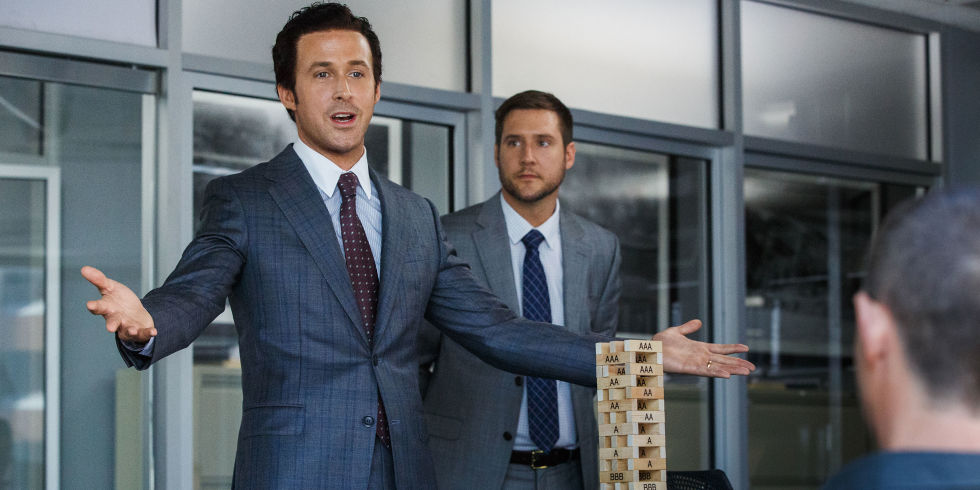
Before seeing “The Big Short”, I really had no idea how the housing market worked, or even what it meant to “short” something. The film does an excellent job of explaining these topics as well as more nuanced aspects of the housing market such as the role of Collateralized Debt Obligations (CDO’s) and AAA mortgage ratings and a slew of other confusing topics. McKay manages to have a ton of fun with the necessary but otherwise boring explanations in the film. For example, there is a scene where Margot Robbie describes subprime loans while sipping champagne in a bubble bath. In another scene Jared Vennett stacks up a tower of Jenga blocks to help Baum's hedge fund visualize the housing market's structure. Regardless of the actual events, this approach is extremely effective and totally unique. It gives "The Big Short" a boost of energy by tackling subjects that could easily bog down the flow of the film and bore the audience.

The story takes place from 2005 to 2008 and another intriguing technique in the "Big Short" is how McKay shows the passing of time. Instead of using inter titles or narration, there are flashes of pop culture videos and sound bites from celebrities to show how the country was changing and kept distracted while the bomb that was the housing market ticked away. This method is entertaining, but also allows McKay to critique another aspect of American culture. One of the opening lines of the film points out that Burry saw the inevitable downfall of the housing market because he did what no one else did, or wanted to do, "he looked". Perhaps the Britney Spears interview and Ludacris rap video exemplify that American culture is such that we'd rather “enjoy the show” than face reality. This goes for the greedy bankers and innocent civilians alike.

Aside from the undeniably amusing and effective style of "The Big Short", the strongest asset of the film can be found in the characters. Christian Bale and Steve Carell turn in moving performances as Michael Burry and Mark Baum. Both men are eccentric and awkward in their own ways, but each also faces personal battles that transcend the initially comical feeling of the film. In all the movies I've seen I have never experienced such polarization in the use of comedy and drama as in "The Big Short”, it is both a laugh-out-loud comedy and a leave-the-theater-in-dead-silence drama.

I've seen the “The Big Short” three times now. The first was with my ideologically and politically conservative parents. The second time I saw it on a date with a wicked smart, super pretty girl. And the third time, I was with some guys from my college fraternity. Three separate experiences, three different kinds of movie companions, but each time I was seeing the same movie. Why am I telling you all of this? Well, I guess what I'm trying to say is that this film is accessible. Its versatility is extremely rare and that is what makes the film so great. Seldom do you come across a well acted, concise, hilarious, moving, and culturally important film that can reach so wide an audience. "Spotlight" is still my movie of the year, but "The Big Short" is the kind of film I'll watch again and again. Re-watchability is something that often comes at the price of depth and "The Big Short" manages to beat the odds.

- S/O to Rex for the recommendation.

February 07, 2016 /Robert Doughty
Comment

"The Revenant" Review

January 16, 2016 by Robert Doughty

OP-ROB RATING: ALL-STAR

                 "The Revenant" is a film directed Alejandro González Iñárritu about the legendary mountain man Hugh Glass, portrayed by Leonard DiCaprio. In the opening scenes Glass and his son Hawk (Forrest Goodluck) escape an Indian attack with a few members of their hunting party. As arrows fly from every direction, the men load as many animal pelts as possible onto a river boat and push off down the water. As the “scout” for the group, Glass suggests they ditch the boat and move up on land. The captain of the outfit, Andrew Henry (Domhnall Gleeson) supports the decision despite backlash from a brutish hunter named John Fitzgerald (Tom Hardy). During the trek, Glass scouts ahead of the others and is surprised by a mama grizzly bear that mauls him beyond recognition. Somehow he survives and is left in the care of his son, Fitzgerald, and a teenager named Jim Bridger (Will Poulter) while the rest of the hunters move on to safety. Fitzgerald quickly gets antsy, and tries to suffocate Glass who seemingly agrees to the idea. However, Hawk interrupts the execution and confronts Fitzgerald who promptly stabs the young man to death while Glass, whose throat has been slashed by the bear, lies on a stretcher completely helpless. Ultimately, Fitzgerald hides Hawk’s corpse and dupes the kind-hearted Bridger into leaving Glass behind by falsely telling him of an impending Indian ambush. The rest of the movie is devoted to Glass and his journey back from being left for dead.


            Iñárritu’s style of filmmaking is simply captivating. His signature whip-pan movements and long takes immerse the viewer into the wild. In dynamic scenes such as the one where the hunters are attacked by Indians and shortly after when the bear horrifically mangles Glass, Iñárritu manages to create a sense of omniscience and simultaneously, total clarity. With “The Revenant” Iñárritu has made a film that looks painfully real; the wind and ice seem to bleed through the screen. It is Iñárritu’s first film since "Birdman", which won him Academy Awards for best picture and best director. In many ways, "The Revenant" seems to be the antithesis of "Birdman". This film isn't confined to a city and a dialogue heavy plot; instead the story occurs in a place that seems a million miles from civilization. Every shot reveals nature in its most raw form. From the streams to the trees to the vast mountainous landscapes, "The Revenant" is truly mesmerizing and beautiful.


             Despite superb filming, intuitive directing, and powerful acting, “The Revenant” falls short because there simply isn’t much to think about upon the film’s conclusion. While Glass’ journey is intriguing, his motivation to survive culminates in a bleary final scene in which he finds that revenge is in God’s hands and not his own. “The Revenant” is much more of a visual experience than a thought-provoking film. It’s hard to glean any meaning from watching a groaning, bloody pulp of a man crawl his way through the snow for two and half hours. If anything, “The Revenant” succeeds most in presenting the American West as a harsh environment inhabited by even harsher people.


          There are a few flashbacks that provide some context for Glass’ identity, but nothing concrete. In truth, very little is revealed about any of the characters. The main villain is John Fitzgerald. Tom Hardy probably didn’t have to spend too much time getting into character because Fitzgerald is equally rambling and incoherent as was Max Rockatansky, who Hardy portrayed this past summer in “Mad Max: Fury Road”. Unlike Max, however, Fitzgerald is singularly selfish and unlikeable. He spends the majority of the film stomping around and grunting racist comments about Indians. Poulter shows more depth as Jim Bridger, who is truly conflicted over leaving Glass out in the wilderness to die, but never gets enough screen time to fully develop. DiCaprio turns in an incredible performance as Glass, but does far more suffering than speaking. 


          There is a scene early on in the film where Glass excruciatingly drags himself along the ground gripping handfuls of dirt and snow that scrape against his flayed fingers. After consoling the frozen corpse of his son, Glass manages to crawl into a clearing onto the edge of a cliff revealing a vast and gorgeous valley below. This scene captures the essence of “The Revenant”.In a place dominated by violence and gore there is also tremendous beauty. The film is hard to watch, but there are often moments where you just have to sit back and appreciate the way the camera moves and the striking imagery it reveals. With “The Revenant”, Iñárritu proves his mastery of filmmaking while DiCaprio proves his depth and breadth as an actor. While a lack of narrative and meaning hold “The Revenant” back from greatness, the film overcomes it’s plot deficiencies through outstanding imagery and a masterful display of directing and acting.


January 16, 2016 /Robert Doughty
1 Comment

"Star Wars Episode VII: The Force Awakens" Review

December 26, 2015 by Robert Doughty

OP-ROB RATING: STARTER

“Star Wars Episode VII: The Force Awakens” is the latest installment of the “Star Wars” movie franchise conceived by George Lucas. The series opened in 1977 with “Star Wars Episode IV: A New Hope”.  Being part of the most famous movie series in film history, “The Force Awakens” has received a considerable amount of hype over the past few years, ever since its official announcement in 2013. The man in charge of living up to this tsunami of expectation is director J.J. Abrams. Fortunately, Abrams is no stranger to this type of pressure, he handled “Mission: Impossible III” in 2006 as well as “Star Trek” and “Star Trek: Into Darkness” in 2009 and 2013, and received critical acclaim for his work with the treasured franchises. With “The Force Awakens”, Abrams has once again employed his ability to craft a blockbuster that appeals to old and new fans alike.

             As the iconic opening credits explain so well, the Galactic Empire has fallen and Luke Skywalker (Mark Hamill) has disappeared. The power vacuum created by the Empire’s demise has been filled by the equally sinister “First Order”. Combatting the First Order is the “Resistance” led by General Leia Organa (Carrie Fisher). In the opening scene the best fighter pilot in the Resistance, Poe Dameron (Oscar Isaac), is on the arid planet of Jakku looking for a map that leads to Luke Skywalker. Dameron finds the map, only to be ambushed by stormtroopers of the First Order.  To ensure the map’s safety, Dameron stores it in his droid, BB-8, who escapes the stormtrooper attack and rolls off into the desert. BB-8 is fortuitously scooped up by a “scrapper” girl named Rey (Daisy Ridley), who quickly learns the droid’s story. Meanwhile, Dameron is taken prisoner by the First Order and interrogated by Kylo Ren (Adam Driver), a dark lord with extraordinary force powers. Ren obtains knowledge of BB-8 from Dameron and informs the First Order of the droids importance.

            In the midst of this opening, Rey emerges as one of two main protagonists, the other being a stormtrooper known as FN-2187 (John Boyega). During the village attack on Jakku, FN-2187 witnesses a fellow stormtrooper and presumably a friend die in thick of the fight. The dying stormtrooper reaches up to FN-2187 and in doing so wipes some blood onto the clean, white helmet. This simple detail marks an otherwise anonymous stormtrooper, and shows a glimpse at actual blood, something rarely seen in the Star Wars universe. In this brief moment of foreshadowing we are introduced to FN-2187, or “Finn”, as he is later known in the film. Finn makes it out of the battle alive, but emotionally disturbed and disillusioned with the First Order. Post-interrogation, Finn breaks Dameron out of the war cruiser and together they steal a “TIE Fighter” which they crash-land back on Jakku. Through a series of events Finn eventually links up with Rey, and their adventure begins.

            Knowing the high-stakes, Abrams doesn’t venture very far off of the battle tested Star Wars formula. Summarily there is a “Death Star”-like threat to the galaxy that must be stopped; Rey and Finn are the main heroes; Kylo Ren is the lead villain. While it is Rey, Finn, and Ren that drive the story’s narrative, there is a slew of supporting characters both new and old. Princess Leia returns as General Leia Organa, Han Solo (Harrison Ford) and Chewbacca (Peter Mayhew) also make substantial contributions to the new adventure. Other characters include General Hux (Domnhall Gleeson) who runs the more technical side of the First Order, much like General Moff Tarkin (Peter Cushing) did in the original trilogy; in addition, the appears the mysterious Supreme Leader Snoke (Andy Serkis) who resembles Emperor Palpatine (Ian McDiarmid) from both of the older trilogies.

             “The Force Awakens” is a passing of the baton from one era to the next. It pays homage to an older, much beloved series while spreading seeds for the new generation. This strategy keeps the film relevant to both seasoned fans and people seeing “Star Wars” for the first time. It's also what holds “The Force Awakens” back from being truly great. The film is caught in between two visions, and can't live up to either. The older characters are less potent, and the new ones are not well developed. Abrams devotes too many scenes to old characters that don’t necessarily contribute to the story, and wastes dialogue on references to previous films in order to generate laughs or strike a sentimental note. The biggest disappointment of the film is Kylo Ren. I was expecting an intimidating, formidable foe but instead saw a spoiled, insecure, little punk. While I respect Abrams more humanistic approach to creating a villain, Ren just cannot be taken seriously. In more than one scene he reacts to bad news by throwing a hissy fit and slashing up expensive consoles with his fancy lightsaber like a toddler. On the light side, the strongest assets of “The Force Awakens” are both Rey and Finn. Daisy Ridley and John Boyega bring a level of emotion to their respective characters that is seldom seen even in the original trilogy.

               While the film isn't groundbreaking on its own, it certainly shows great promise for the future. Rey and Finn are both extraordinary heroes that I'll look forward to seeing more of. Now that older characters have been dealt with, the story can move on into a world of endless possibilities. While Abrams first Star Wars outing feels a bit stuck in the past, it sets an exciting precedent for subsequent films. 

December 26, 2015 /Robert Doughty
1 Comment

"Creed" Review

December 09, 2015 by Robert Doughty

OP-ROB RATING: ALL-STAR

“Creed” is the newest installment of the “Rocky” series, which it reflects in many ways. However, this time around Rocky (Sylvester Stallone) is old and in very poor health. He doesn’t throw a single punch. If the title of the film isn’t clear enough, the main focus is on Adonis “Donny” Johnson/Creed (Michael B. Jordan), the illegitimate son of the great Apollo Creed (Carl Weathers). For those that haven’t seen the films, Apollo was one of Rocky’s greatest rivals and friends who died in the ring before his son was born. In the opening scenes we are introduced to the rowdy, troubled little boy named Adonis who is spending his time in a youth penitentiary when Mary Anne Creed (Phylicia Rashad), Apollo’s widow, shows up to take in the young boy as her own. Donny then grows up in the Creed’s L.A. mansion and despite an education and a great job, opts to pursue a career in the ring as a boxer.

In most ways, “Creed” is similar to any other “Rocky” movie. The main hero is introduced with challenges and obstacles that he must overcome. There is a love interest fulfilled by a musician named Bianca (Tessa Thompson).  There are training montages and a culmination scene in the same spirit as the very first “Rocky”. Ultimately Donny ends up in the ring with a formidable fighter named “Pretty Ricky” Conlan (Tony Bellew) and must face everything he has learned and struggled to achieve. While all of these events may seem cliché and boring, “Creed” finds ways to become unique and take on a name of its own.

A defining hurdle that Donny must jump is his own privilege. Unlike most fighters, he has come from considerable wealth and opportunity. When he first shows up to a gym in Philadelphia, the trainer belittles him by giving him the nickname “Hollywood”. Even after proving his toughness with a solid victory against a hardened Philadelphia fighter, Donny still faces the challenge of earning the name Creed. Another key plotline is that of the old hero, Rocky Balboa. Rocky has finally hung up the gloves and is even reluctant to enter a boxing gym before Donny is able to convince him to become a trainer. Seeing the Italian Stallion so beaten down is quite sobering, but it confronts an actuality that the previous “Rocky” film, “Rocky Balboa” vehemently denied.

“Creed” excels under the direction of Ryan Coogler, who has worked with Michael B. Jordan before on the film "Fruitvale Station". Some of the most exhilarating shots in the film come in the big fight with Conlan. Instead of randomly circling the fighters, Coogler sets the camera over the shoulder of the man with the upper hand in the fight.  It goes from Conlan to Donny and back again throughout much of the boxing match. In "Creed" the ring feels more brutal than in previous "Rocky" films, with shots of blood splashing the mat and deep gashes being sealed up. The streets of Philadelphia also come to life in a way that showcases the reality of the city. There are scenes with dirt biker gang’s in the road; in another scene Bianca takes Donny to a local cheesesteak dive. Without romanticizing anything Coogler manages to bring authenticity to the story. Knowing the grit of the streets and the brutality of the ring is crucial for Donny to become a Creed. It is also necessary to the viewer in order to be fully immersed in the story.

The weaker points of "Creed" are in the storylines involving his mother and his girlfriend. Rashad gets maybe ten lines as Mary Anne Creed, and she essentially disappears after the first scene only to return when watching the big fight from her home in L.A. Bianca also feels dispensable to the story. Even though her character is intriguing, she doesn't add to Donny's character like Adrian (Talia Shire) did for Rocky in the first film. She basically serves as the token love interest and little else. While both of these roles were convenient for the story, their lack of purpose takes away from the final product.

Despite a relatively long run time of 133 minutes “Creed” keeps an impressive pace. The film builds steady momentum and the final fight is truly thrilling. In an ending scene that is both original and sentimental, “Creed” finishes on very strong footing in lieu of a few missteps here and there along the way. While "Creed" is not necessarily anything new, it manages to shake up an age-old story enough to bring new sparks to the narrative. With a powerful soundtrack and convincing performances from both Jordan and Stallone, "Creed" is a winner, even if by split decision.


December 09, 2015 /Robert Doughty
Comment

"Spotlight" Review

December 03, 2015 by Robert Doughty

OP-ROB RATING: LEGEND

“Spotlight” is a film directed by Thomas McCarthy about The Boston Globe’s investigation of sex abuse within the Roman Catholic Church in and around Boston. Within the Globe, the particular investigative team is called “Spotlight” and is led by Walter “Robby” Robinson (Michael Keaton). Michael Rezendes (Mark Ruffalo), Sacha Pfeiffer (Rachel McAdams), Matt Carroll (Brian d’Arcy James), and Ben Bradlee (John Slattery) make up the rest of the investigative team. In the opening scenes these characters roam about the busy office of the Globe working on finding a new topic that deserves Spotlight’s attention. Their choice is essentially made for them when the new editor of the Globe, Marty Baron (Liev Schreiber), pushes Robby to investigate the Catholic Church and the possibility of a sex abuse scandal involving more than a few rogue priests. As a new editor, a Jew, and a non-Bostonian, Baron is not the most popular man in the office at the beginning of the film. Despite a fair amount of pushback, Robby and his team reluctantly begin work. Within the first couple weeks of investigation, the Spotlight team discovers that they have stumbled upon something far bigger than expected. As each reporter discovers more bad priests, more victims, more cover-ups, and more excuses, the story might risk losing focus. However, in “Spotlight” McCarthy sticks to the actual reporters, as each is affected by the investigation in different and profound ways.

“Spotlight” deals with such horrific issues that it is often hard to watch. In one scene where Sacha interviews a survivor, she explains that he must give more detail than simply saying, "molested". For the sake of her story she needs to know exactly what happened. Many of the interviews with victims are disturbing and gut-wrenching. As the film reveals, many of the individuals who are molested by priests go on to lead abject adult lives filled with emotion instability, drug addiction and sometimes suicide. The scenes with survivors revealing sickening details are tough to sit through, but even tougher are the scenes where the bigger picture is revealed. The revelation that it is not just “a few bad apples” in the priesthood is the hardest to stomach. A watershed moment in the film comes when an expert reveals to the Spotlight team that extensive research indicates that 6% of priests are involved in pedophilic activity during their careers. After hearing this statistic the team simply sits in shock; so does the audience.

The most impressive aspect of “Spotlight” is the simplicity of the film. Most scenes are presented an unloaded frame, with people simply speaking to one another. Characters talk to each other and McCarthy allows them to act instead of constantly cutting to close-ups or ramping up a shot. While all of the performances are excellent, the very best are delivered by Stanley Tucci as Mitchell Garabedian and Mark Ruffalo as Michael Rizendes. Garabedian is an explosive lawyer for those affected by pedophile priests. He is a man who knows just how horrible the situation is and how evil the are actions to cover it up. Rizendes is one of the reporters on the story, and the investigation pulls at him the most visibly. As a lapsed Catholic, Rizendes explains in one scene how he thought that he would always return to the faith. Even though he was no longer a practicing Catholic, the fact that it was still there for him was important, and what Spotlight has discovered has destroyed any possibility of return to the church. As Rizendes finishes his thought, he explains to Sacha that it’s a “shitty feeling”.

  I had seen the Alex Gibney documentary “Mea Maxima Culpa: Silence in the House of God” before seeing “Spotlight”, so I was pretty familiar with this widespread problem. Gibney’s documentary is quite good, but it gets so wound up in the overall spectacle of the scandal that it feels somewhat detached. “Spotlight”, however, is anything but distant. The dialogue is intuitive and stimulating. Each progression of the story is pointed and concise. While the issue of sexual abuse within the Catholic Church is a major theme of the film, “Spotlight” is focused on the courageous men and women who brought it to light. While it is certainly not a film that I would watch for enjoyment, “Spotlight” is a superb work of film, and vitally important as a topic of contemporary society.

December 03, 2015 /Robert Doughty
Comment

"Spectre" Review

November 08, 2015 by Robert Doughty

OP-ROB RATING: BUST

When Daniel Craig was first cast for the role of James Bond, a great many people swore he was too short, too coarse, and too blonde. Ian Fleming probably rolled over in his grave when the decision came out. However, with "Casino Royale", Craig not only proved he deserved to be 007, but also added an unprecedented level of depth to the storied character. With uneven storytelling, "Quantum of Solace" took a step back from the excellence of "Casino Royale", but Blonde Bond came surging back to life under the direction of Sam Mendes with “Skyfall” in 2012. Now, in what may be his last outing, Daniel Craig is back in the new film “Spectre” with Mendes again directing.

Picking up from "Skyfall", Bond is still trying to stop a secretive web of enemies, meanwhile trying solve mysteries from his past. Starting off in Mexico City and bouncing from there to London, Rome, Austria, Tunisia and back to London, Bond picks up clues and ultimately comes face to face with his most powerful opponent yet. This villain is his estranged step brother, Ernst Blofeld played by Christoph Waltz. "Spectre" is a quite beautiful and stylish affair. The locations shot in the film are striking, with the snow covered Austrian mountains, the streets of Rome and London, and the sandy desert in Tunisia. Even the polluted streets of Mexico City look terrific. Bond and his main female companion in the film, Dr. Madeleine Swann (Lea Seydoux) can be observed wearing fine designer clothing looking like they just stepped out of a photo shoot with Vanity Fair.

“Spectre” is visually tantalizing, however the story that unfolds is far less exciting than the visuals and the action scenes.  Unlike its predecessor, "Spectre" opts for the typical Bond formula. There are several sexual encounters, a brutish henchman, an evil lair, and a cerebral super villain. Sam Mendes includes some nice throwbacks to the old Bond films, but the story lacks any real substance. The most confusing aspect of "Spectre" is the main love interest, Dr. Madeleine Swann. Bond and Swann meet briefly and inexplicably fall in love after a few short scenes, but the relationship is never developed/explained. Another shabby piece of "Spectre" occurs when Bond is subjected to torture by tiny needles that literally do nothing. In the very same scene the “super smart” Blofeld makes the boneheaded mistake of not confiscating Bond's watch which any old bloke knows can just as easily blow up as tell the time. If that’s not baffling enough, Bond manages to shoot down a helicopter with one nicely placed bullet from his Walther PPK pistol. These things cross the line and make “Spectre” feel more like a satire about spy films rather than a serious Bond film.

The funniest and most memorable scene in the movie happens when Bond confronts a mouse that scurries into his hotel room in Tunisia. Sitting, slouched in a chair drinking a Heineken, Bond points his pistol at the rodent and asks, "Who sent you? Who are you working for?" Besides the humor, this is one of the few scenes where Bond becomes human. He's just a guy drinking beer and having a little fun. It's this more relatable side of Bond that made Craig a game changer. When the hero has “Everyman” qualities it makes his story more believable and realistic to the viewer. This same idea can be seen in "The Dark Knight" when the mighty Batman strains in his office chair trying to stitch his own shoulder up. Unfortunately, "Spectre" misses the opportunity to reveal more of the character of James Bond, and opts for cheap thrills and a rickety storyline resulting in one of the biggest disappointments this movie season.

November 08, 2015 /Robert Doughty
Comment

"Steve Jobs" Review

October 28, 2015 by Robert Doughty

OP-ROB RATING: ALL-STAR

       The most recent biopic of the Apple icon Steve Jobs is directed by Danny Boyle (“Slumdog Millionaire”, “127 Hours”) and written by Aaron Sorkin (“The Social Network”). The film is simply titled, “Steve Jobs” and stars Michael Fassbender in the lead role. The majority of “Steve Jobs” takes place in three, approximately one-hour windows in 1984, 1988 and 1998, right before the launches of the Macintosh 128k, the NeXT Computer and finally the iMac. The theme of chaos before each launch is crystallized when Steve Jobs (Michael Fassbender) sighs and tells his colleague and confidant Joanna Hoffman (Kate Winslet), “It’s like five minutes before every launch everyone goes to the bar and then tells me what they really think of me.” Several flashbacks are sprinkled throughout the film, including the iconic founding of Apple in Jobs’ parents’ garage in Los Altos, California, as well as the “firing” of Jobs after the commercial failure of the Macintosh.


       Within the scaffolding of these three major events, "Steve Jobs" narrows in on three different relationships, each of which reveals a definitive piece of the main character.  These three people are John Sculley (Jeff Daniels), the former CEO of Apple; Steve Wozniak (Seth Rogen), a fellow co-founder of Apple; and Lisa Brennan (Perla Haney-Jardine, Ripley Sobo, Makenzie Moss), Jobs’ daughter.


         The Sculley and Jobs relationship is one of rival ideologies. Sculley is trying to run a company the produces some form of profit, while Jobs is more focused on what he believes to be the future. Jobs’ ideals are made clear through his unrelenting devotion to a “closed system”, denying customization of the Macintosh, NeXT and iMac computers. Sculley understood at the time of the Macintosh’s release, that a closed system fatally inhibits sales. This is just one of the many examples of Jobs’ futuristic vision getting in the way of immediate financial success of the earliest Apple computers.  (You say “one of many examples” – are there others in the movie?)  In the scene where Jobs is voted out by the shareholders in an ultimatum, Jobs exclaims, “I sat in a garage and invented the future because artists lead and hacks ask for a show of hands."


            Another major facet of the film is Jobs’ friendship with Steve Wozniak. Throughout the film, Wozniak seeks recognition from Jobs for his part in starting the company as well as creating the Apple II computer. The Apple II was the company’s first commercial product that had been funding the Macintosh. Jobs had very little to do with its design and function and refused Wozniak a public acknowledgement at the launch of the Macintosh in ‘84. Before the launch of the NeXT, Wozniak and Jobs have a heated conversation in the orchestra bay of Davies Symphony Hall in San Francisco. At this point in the story, Jobs has gained incredible fame and is recognized as a genius while Wozniak remains unknown. Feeling slighted, Wozniak lashes out at his friend saying, “You can’t write code. You’re not an engineer. You’re not a designer. You can’t put a hammer to a nail. I built the circuit board… What do you do?” Boyle and Sorkin uncover another piece of Jobs’ persona when he responds, “I play the orchestra. And you’re a good musician. You sit right there (pointing to an empty chair). You’re the best in your row.”


            Finally there is the relationship between Jobs and his daughter, Lisa Brennan. In 1984, Jobs refuses to acknowledge any relation to the little girl, citing a “twenty-eight percent chance” that her father could be any man in America. In the scene before the iMac launch in 1998, it is revealed that Jobs has refused to pay Lisa’s college tuition fees. This aspect of Jobs’ life is the most complicated and raises the most questions about his moral standing and legacy. However, in the film’s dramatic culminating scene Jobs seems to come to terms with his daughter and they share a tender moment together.


           "Steve Jobs" presents a muddled picture of a man most people want so desperately to celebrate and admire. The facts of the film have been hotly disputed by Jobs' former friends, colleagues and family. However, in a biopic such as this do the details matter as much as the attitude? Every human being who has had the opportunity to use an Apple product is aware of Steve Jobs' brilliance and innovation. What Danny Boyle and Aaron Sorkin have done with "Steve Jobs" is make us aware of his complexity. Whether or not the drama is 100% accurate, "Steve Jobs" is an immersive and intriguing exploration into the character of the most influential businessman of the past five decades.


October 28, 2015 /Robert Doughty
Comment

"Sicario" Review

October 19, 2015 by Robert Doughty

OP-ROB RATING: LEGEND

In Mexico, Sicario is a word for hitman, it is also the title for Denis Villeneuve’s latest film. The majority of “Sicario” takes place in arid places where law and order has dried up along with the water. Kate Macer (Emily Blunt) is an FBI agent specializing in kidnappings who has just led a raid on a house in Arizona filled wall to wall (literally) with bloody corpses. The raid also resulted in the untimely death of two police officers. In order to exact revenge on the men responsible, she agrees to get onboard with a Department of Defense joint operation with Matt Graver (Josh Brolin) and his steely eyed colleague Alejandro (Benicio del Toro). A complete outsider to the inner workings of the cartel, Kate asks Alejandro if there is anything she should know, his response is, “You’re asking me how a clock works. For now let’s just keep an eye on the time.” The first stop for the group is in El Paso, Texas, where they link up with a team of Delta Force soldiers and a few Texan Deputies. Before she has time to think, Kate is strapped into a bullet-proof vest and driven across the border into Ciudad Juarez where she gets her first full dose of harsh realities surrounding the Mexican cartel.


Silence is the defining element in “Sicario”. The majority of the film is accompanied solely by diegetic sound, loud noises are sparse in between conflicts. As a result, moments of gunfire sound louder, and feel more intense. The background music in the film comes from the award-winning composer Jóhann Jóhannsson. Denis Villeneuve only cues the music when a scene is being built up. The moments of greatest suspense occur when people are allowed to just stare at each other, or sign a piece of paper in complete silence. This style of filmmaking is such a far cry from most action movies released today that are so noisy in their entirety, and boy is it refreshing. The quiet scenes allow time to think about the potent message that “Sicario” delivers.


In a scene near the end of the movie, a group of soldiers (including Kate, Matt and Alejandro) descend a hill into hostile territory. The silhouettes of armor clad operatives get consumed by the blackness against the backdrop of a beautiful desert sunset. As far as the audience is concerned, there are two worlds that exist in “Sicario”, one is defined by law and procedure, and the other by competition and havoc. Each has a measure of justice that must be exacted. “Sicario” brings into question the means by which order is achieved in the darkness.


Josh Brolin turns in a familiar performance as Matt Graves, a smug Texan reminiscent of Llewelyn Moss from the Coen Brothers’ masterpiece “No Country for Old Men”. Benicio del Toro is equally convincing as Alejandro, a poised assassin with knack for interrogations and a surprising amount of depth. Emily Blunt delivers an inspired performance as an embattled idealist. Her character, Kate, must either come to terms with unforgiving realities or cling to her principles in the face of certain death. One of the secondary characters in “Sicario” is a corrupt Mexican cop named Silvio (Maximiliano Hernández). In most action thrillers, Silvio wouldn’t have a backstory, he would simply serve his role as a nameless bad guy. In “Sicario” however, Silvio is not only given a name but also a home, a wife and a son. The audience is given a window to see what his life is like in the small town of Nogales. For a movie essentially titled “hitman”, this complexity is surprising. “Sicario” is a complex, intense, and culturally important film that isn’t afraid to test the boundaries of the war on drugs. It is the best film I have seen so far this year.


October 19, 2015 /Robert Doughty
1 Comment
  • Newer
  • Older

Powered by Squarespace