"Oscar Nominated Short Films 2017: Animation" Review
Borrowed Time - OP-ROB RATING: BUST
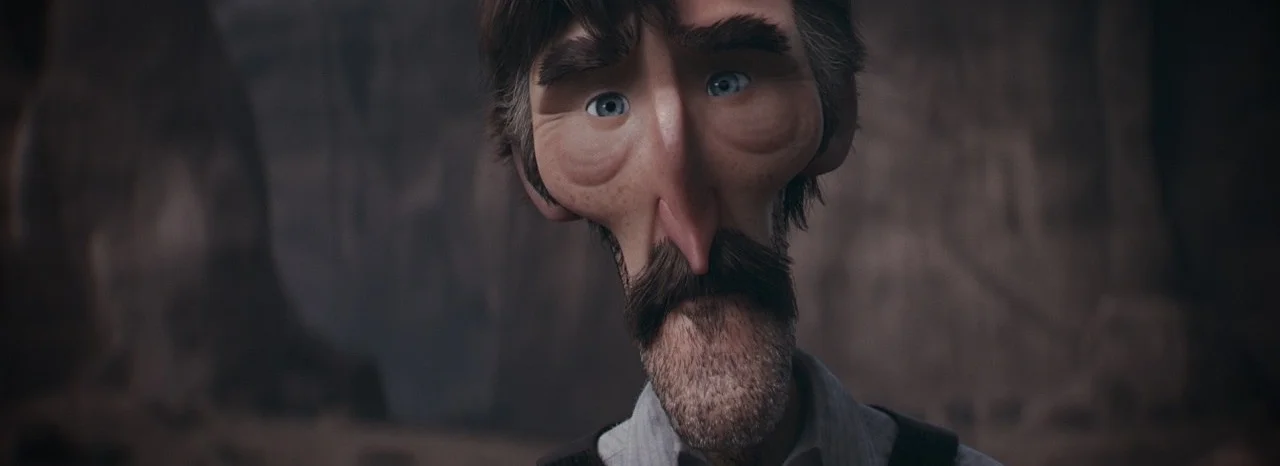
From Andrew Coats and Lou Hamou-Lhadj, “Borrowed Time” is a short film from two Pixar animators that worked on feature films such as “Inside Out”, “The Good Dinosaur” and “Brave”. This connection can be readily observed in the faces of the sole two characters in the 7 minute short. The film opens with a gruff, western sheriff approaching a cliff overlooking a vast canyon. However, this man does not have the look of your typical sheriff. He has a long face with sad eyes to fit a tall yet thin frame. He slowly walks toward the edge of the cliff past some debris including pieces of a wagon and a horse skeleton. The film shifts to a flashback of the sheriff as a teenager, with brightness in his eyes and face, sitting in a wagon with his oddly bulky father who is a sheriff himself. However, the calm of the moment is shattered when a group of bandits chase after their wagon and drive them to crash near the edge of the cliff. As the flashback cuts in and out, a damning series of events lead to the older sheriff’s death. The teenager fails to save his father. As the film is brought back to the present, we are wondering if this now battered old sheriff has decided to call it quits and throw himself from the cliff into the vast canyon.
The bright spot in “Borrowed Time” is certainly the expressions in the face of the younger sheriff. Since there are no words, his face is all we have to read the situation. However, the short film is confusing and depressing. Why would the sheriff kill himself now? He has to have aged like thirty years. On top of that, the climax of the film occurs when the sheriff is teetering on the edge of the cliff and a ray of light refracts off of a pocket watch in the wreckage of the wagon. The sheriff scurries off the edge of the cliff and opens the pocket watch that contains a picture of himself and his father. It is at this sight that the sheriff breaks into tears, and the film ends. Seriously? All this drama for that? While it has many of the redeeming attributes of a Pixar short, “Borrowed Time” is an unashamedly sappy and failed attempt at depicting grief.
Pearl - OP-ROB RATING: STARTER
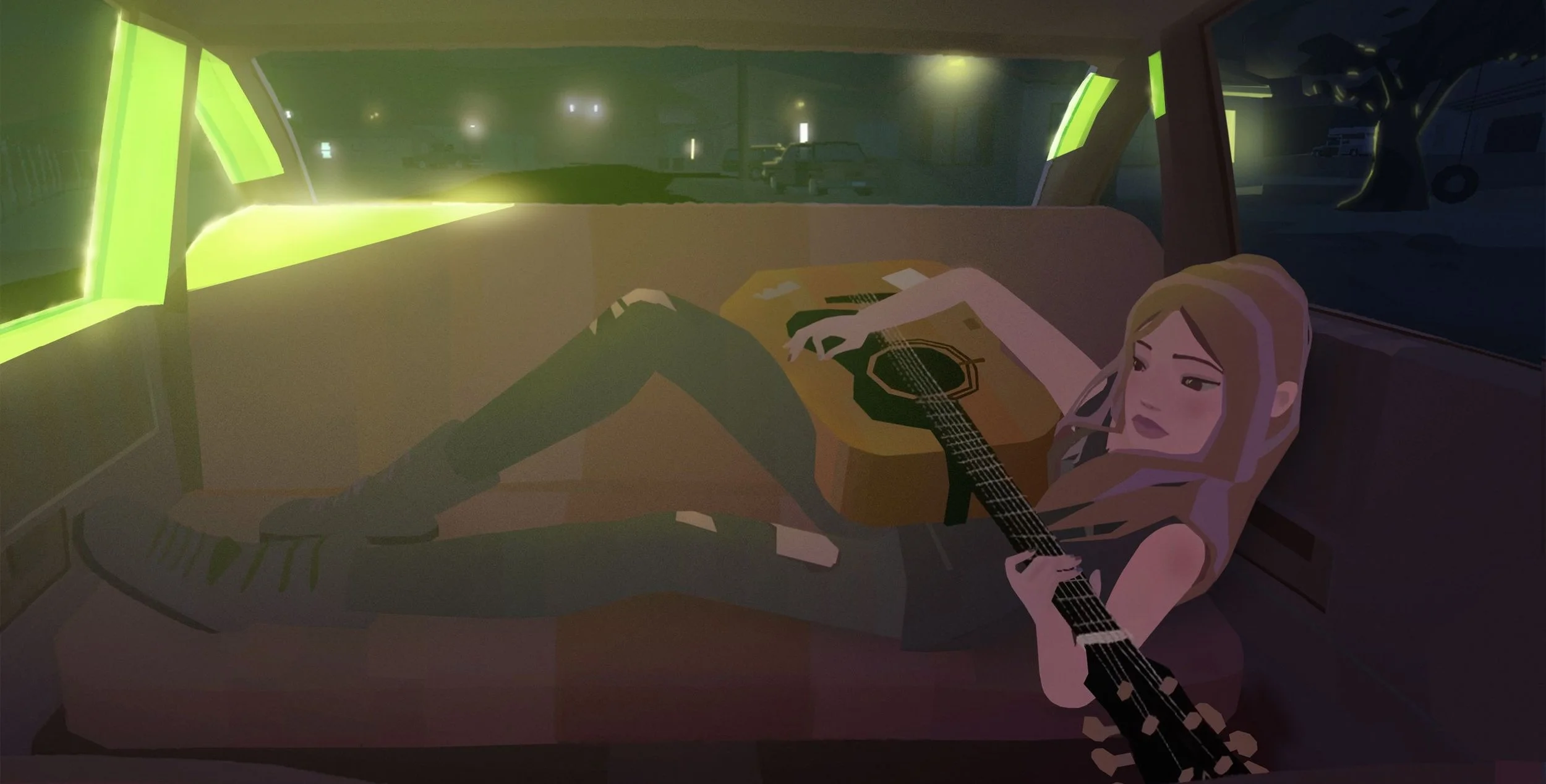
"Pearl" is about a single father who raises his daughter as he drives across the United States in a rickety hatchback trying to make it as a guitarist. The entire story is depicted through the car. He parks and stands outside with his guitar while people listen and sometimes drop money into his guitar case. As Pearl grows, she learns to play as well. While she seems to be having a ton of fun, her father knows that being on the road 24/7 is no life for a little girl. He settles down with a desk job and the story fast-forwards until she has grown into a young woman. Still playing guitar, she takes the car on road trips and joy rides with her friends. Ultimately, she ends up becoming a commercially successful musician. On the way to a concert opening, she picks up her now middle-aged father in the very same car he abdicated for a desk.
All of this occurs in the time it takes for the upbeat song "No Wrong Way Home" to play as a narrative. The 6 minutes are packed with moments of joy, sacrifice, and nostalgia. The low point of the film is the quality of the animation, which looks on par with the kinds of video games you might have played on the original Play Station. The reason for the shoddy graphics could be attributed to the fact that “Pearl” is the first-ever “virtual reality” animation film to be nominated for an Academy Award. You can actually watch the film on YouTube and look around the hatchback a full 360 degrees. Despite the gimmick, “Pearl" is the second best amongst this year’s nominees. In a stronger lineup it may have fallen towards the back. Nonetheless, "Pearl" is a heartwarming story, with a good song, that is undoubtedly worth the 6 minutes.

Piper - OP-ROB RATING: BENCH
“Piper” is Disney Pixar’s contribution to the 2017 nominees and is the story of a baby sandpiper presumably named Piper. The tiny bird is enticed by its mother to shimmy down to the seashore and search for baby clams. However, on Piper’s first hunting trip she fails to retreat with the other sandpipers and is swept under the surf. Traumatized, Piper refuses to come out and hunt again until she notices some hermit crabs going full on into the waves without fear. Piper decides to follow the crabs and discover their secret to outsmarting the surf.
Keeping with the Disney Pixar standard, “Piper” is beautifully animated and methodically scored. The crisp animation of the beachfront scene could easily be mistaken for something from the real life “Planet Earth” series. The music is equally well done. As Piper darts across the beach and dips under the ocean there is a perfectly timed note to accompany every move of her journey.
Despite the quality production of the film, at 6 minutes “Piper” is pretty shallow on meaningfulness. Compared to 2014’s “Feast” and 2012’s “Paperman”, it feels a bit thin. Perhaps Disney Pixar set the bar too high with the aforementioned shorts, which both took home the Oscar for Best Animated Short at their respective Academy Awards. But nonetheless, the bar has been set, and “Piper” offers little more than well-executed cuteness.
Blind Vaysha - OP-ROB RATING: BUST
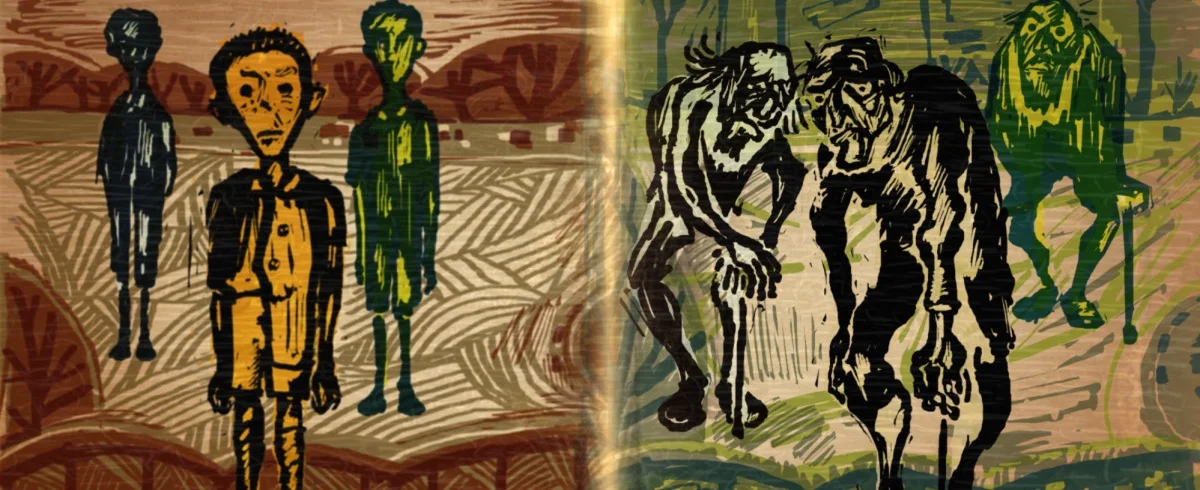
“Blind Vaysha” is a Canadian short about a girl named Vaysha who is born with a terrible curse; she can only see the past out of one eye and out of the other eye she can only see the future. The distance in time between the two eyes varies greatly. For example she may see sunrise and sunset out of the two eyes, but at other times she sees a prehistoric wasteland and then a post-apocalyptic hell. Rough times for Vaysha, who the townspeople deem “Blind Vaysha”. The film details her woes, especially in finding a suitable husband. All of her suitors approach as children out of one eye, and as decrepit old men out of the other.
The story is at first fascinating, but plateaus quickly. The 8-minute run time is dominated by all of the problems Vaysha faces with her terrible curse. As if to end the unsolvable problem of seeing only the past and the future, the narrator turns the curse on the audience and literally asks you to close one eye and then the other and imagine what it would be like. Finally, the narrator drops the hammer with a question that amounts to, “do you fail to live in the present?” Nice try, but I’ll pass on the 8-minute medievally illustrated lecture next time.
Pear Cider and Cigarettes - OP-ROB RATING: LEGEND
“Pear Cider and Cigarettes” was the final short in the lineup and was preceded by a warning for adult themes. When the film was introduced the main thing I noticed was the glaring 32-minute run time inside the parentheses. In all honesty, I was apprehensive about a not so short 32-minute “short”. The film, which is written, directed and animated by Rob Valley, is a personal account of his childhood friend Techno Stypes. The film opens swiftly when Valley receives a letter informing him that Techno has died. The intrigue builds when Rob tells us that he had just gotten back from a trip to China at the request of Techno’s parents. As Valley explains he had two objectives in China, “1. Get Techno to stop drinking long enough to receive the liver transplant, and 2. Get him back home to Vancouver.”
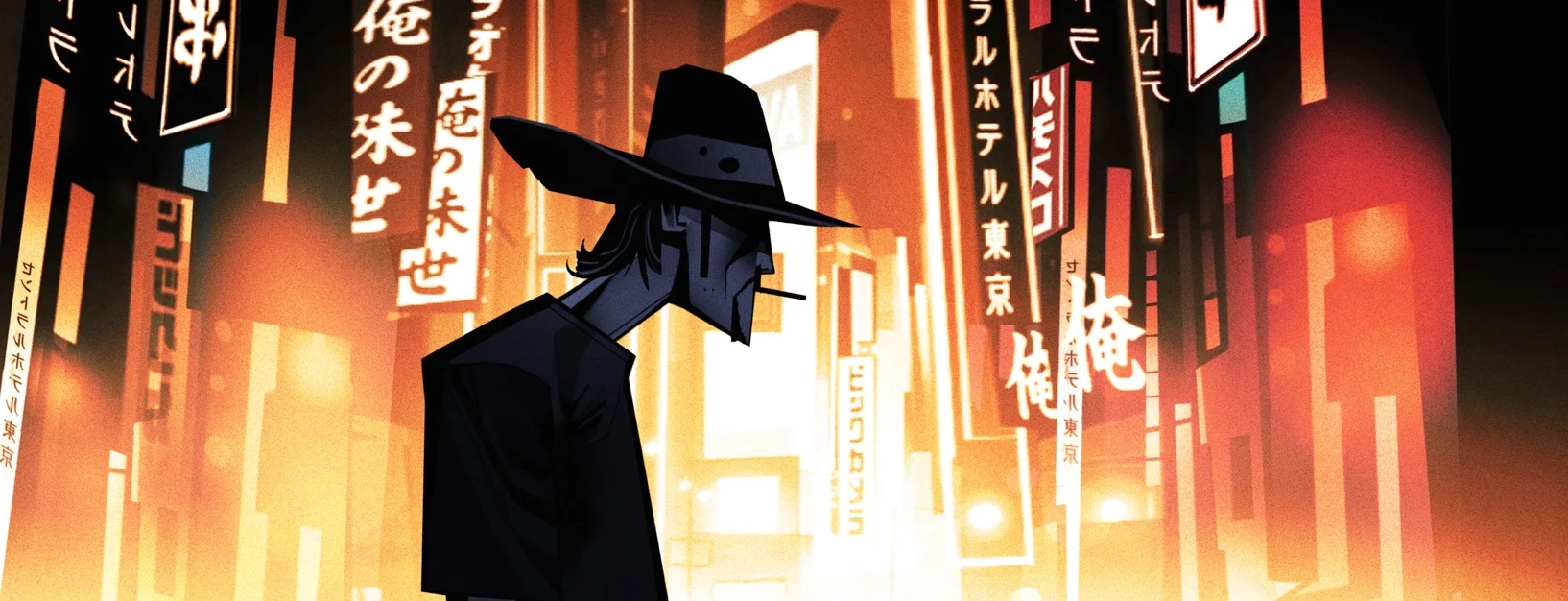
There is not one single aspect of “Pear Cider and Cigarettes” that made it the best film out of the nominees, but rather the cohesiveness of the narration, animation, and story together. Everything just fits perfectly. The darkly animated shots cement the film in a unique kind of noir. Furthermore, by opening with news of Techno’s death, the whole narrative has an investigative feel similar to “True Detective”. Who was Techno? And how did he die? The film is steeped in mystery at the outset and the story momentously unravels.
The animation is sharp, and the slender characters moves in a pronounced, assured way. Techno is portrayed as a sturdy, fast, and powerful young man but eventually becomes lean and rigid as his liver fails due to alcoholism. The cities of Vancouver, BC and Guangdong, China each take on an air of smoky, neon-lit ruthlessness under Valley’s focused artwork. The world in which “Pear Cider and Cigarettes” takes place is real, but dark and unforgiving. Just as the animation fuses to the story, so does Valley’s narration. As a true story, “Pear Cider and Cigarettes” has an extra layer of authenticity and Valley narrates with brutal honesty as he describes the self-fulfilling downfall of his friend Techno. Finally, the background music in “Pear Cider and Cigarettes” adds to the grittiness of the film featuring artists such as Morphine, Queens of the Stone Age, Cypress Hill, and Pink Floyd.
In the end, “Pear Cider and Cigarettes” is a very simple lesson about human nature delivered with distinct style. People want what they don’t have, and those that have everything often can’t seem to find purpose. Techno is one of those rebels without a cause. In a somewhat dull roster of Oscar Nominees, “Pear Cider and Cigarettes” is undoubtedly the sharpest.