
"The Stranger" Review
OP-ROB RATING: LEGEND, RODMAN
In the first season of HBO’s “True Detective”, Marty Hart (Woody Harrelson) muses to his partner, Rust Cohle (Matthew McConaughey), “Do you wonder if you're a bad man?” To which Cohle responds, “No. I don't wonder, Marty. The world needs bad men. We keep the other bad men from the door.” It’s a great line that strikes at the moral realities of men and women that fight crime. Rust’s response also encapsulates the standard for what we most often see in movies that depict law enforcement: toughies going head-to-head, fighting fire with fire. Thomas M. Wright’s 2022 film “The Stranger” takes an alternative approach.
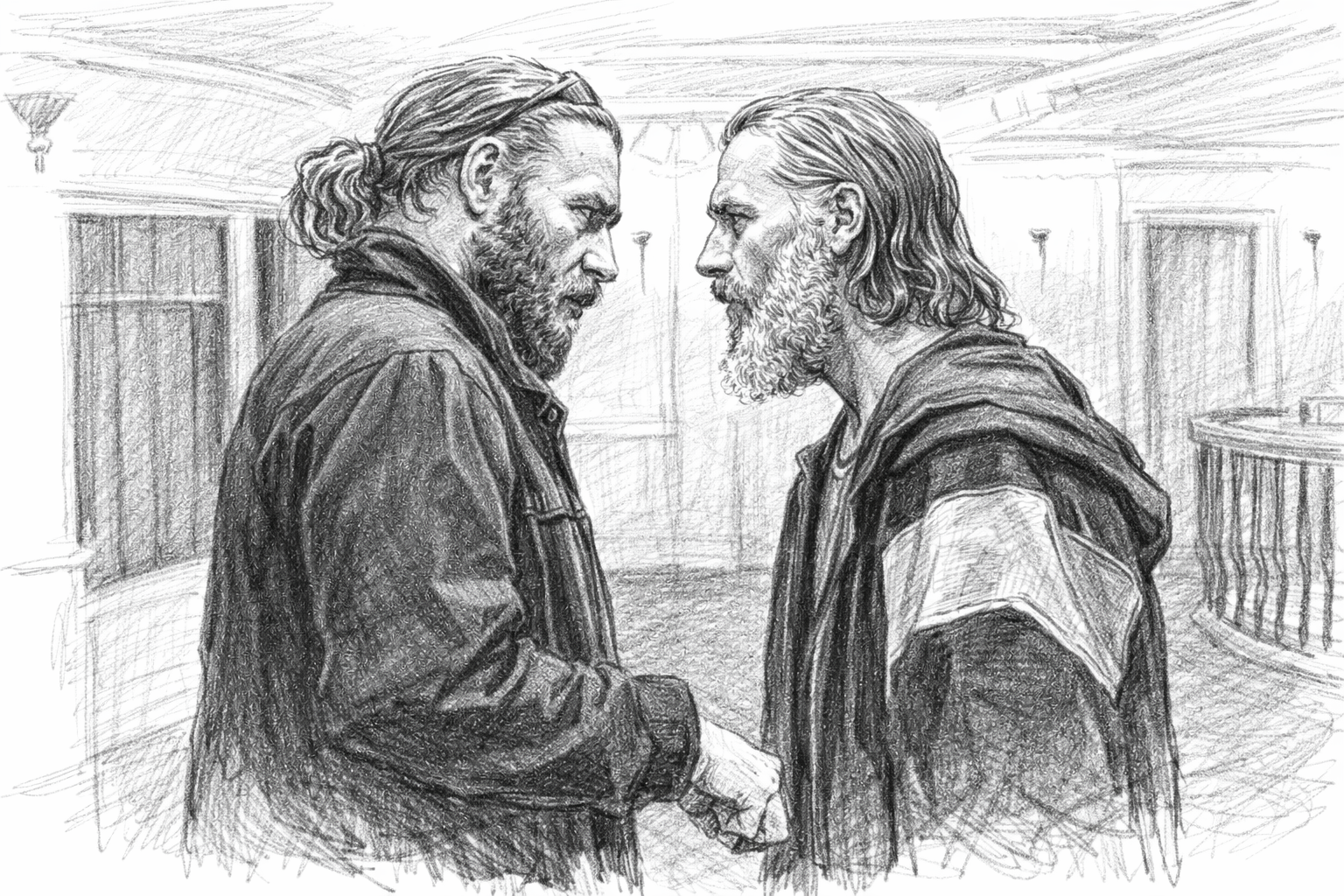
Based on the true story of the 2003 abduction and murder of 13-year-old Daniel Morcombe in South East Queensland, and the years-long investigation to identify his killer, “The Stranger” puts a good man in a situation that requires him to combat evil, not with violence, but with empathy. Joel Edgerton stars as Mark Frame, an undercover police officer tasked with spearheading a “Mr. Big” operation focused on a mysterious man named Henry Teague, who is portrayed by Sean Harris. The film deftly pulls us into the story, with an intro that foreshadows and lays the groundwork for Henry’s character development. Whatever points might be misunderstood in the first 15 minutes of the movie are cleared up later on.
The main focus of the investigation is getting Mark as close as possible to Henry, with the goal of eliciting a confession. Mark is introduced as a no-nonsense lieutenant in a sophisticated criminal organization. The intention is to make Henry feel protected, and instill in him a longing to be brought fully into the organization. Mark takes Henry under his wing, bringing him along on various “deliveries” and “pick-ups”. These taskers provide lots of time for long drives along the barren roads of Western Australia; time during which Mark must build trust and rapport.
A highlight of the film is the decision to slowly but surely give us more information on Henry. You can draw a good comparison to “Shut Up and Dance” from “Black Mirror”, but here the reveal is steadier and more subtle. At first, we don’t feel that Henry is dangerous, or even a bad guy necessarily. As our perception changes, the scenes between Mark and Henry become more and more harrowing. “The Stranger” is not graphic. There is no violence shown. We never get a grisly flashback of the crime. Even the language about violence and sexual assault is restrained. What we do get is an efficient look into the scale of the WAPOL (Western Australia Police Force) operation; both the undercover guys fleshing out the Mr. Big Organization as well as the detectives back at the station. The movie does a tactful job of providing us the actual case-building police narrative without letting it take over entirely.
We are left to take these details into each scene between Mark and Henry. In the second half of “The Stranger”, I started to feel genuinely uncomfortable. My heart was pounding. While some of this physical reaction can be attributed to the look, music, and overall tone of the movie, the primary drivers were the performances of Harris and Edgerton. They are both brilliant. Many will recognize Sean Harris from the “Mission Impossible” franchise. He is a natural villain, with sharp, rat-like features, a wiry frame, and a raspy, seething voice. Harris tempers his bad-guy presence as Henry. He looks creepy, but also seems vulnerable and a bit naive. This restraint provides the canvas for that aforementioned dread-build. Edgerton, for his part, is innately gruff. He is not a “polished” or “pretty” movie star. But he has always had a knack for playing sensitive characters, it's something in his eyes and quiet manner of speech. Both actors soar within their roles.
In terms of comparisons, it is difficult to place “The Stranger” in the canon of undercover cop flicks. There are moments in which we worry that the operation might be blown, but Mark is not put in a threat environment like “The Departed”, nor does he develop some sort of respect or admiration for his case subject, à la “Donnie Brasco” or “Reservoir Dogs”. If there is a past movie that best approximates the uneasiness of “The Stranger”, it might just be William Friedkin’s 1980 film “Cruising”. Both methodically put us uncomfortably close to something sinister through an undercover cop. But where Friedkin relies on visuals from a uniquely dark and seedy subculture to construct his nightmare, Wright does not. Australia is daunting in its remoteness, but the fear is almost solely dialogue driven. The creepiest scene in the movie is when Henry invites Mark into his home to have a beer, where we have to watch Mark squirm. He can’t leave until Henry gets up and puts on a song by the Icehouse that sets a tone on the level of “Goodbye Horses”.
Some might expect “The Stranger” to build towards a towering crescendo and a run of satisfying title cards. For many of us, that is what we desire. Give us closure! You can get closure online, just look up the case (and be summarily enraged by Australia’s lenient justice system). No, that is not the point of the movie. “The Stranger” is a masterful meditation on the fight against evil. There are muted moments of triumph near the end of the film, but the overall feeling is somber. Evil persists. It leaves stains behind. It scars the brave men and women that confront it head-on. The immortal Rust Cohle left us at the end of “True Detective” with a hopeful observation on this struggle: the battle can be won. “The Stranger” does no such thing, and this decision perfectly caps a film that will stick in your gut in such a way that only truly horrific movies can.
On to the categories…
Highlight of the Game: The aforementioned scene in Henry’s house. Nothing actually happens. There is relatively mundane dialogue, they drink beer, and Henry puts on a song. That’s it. But the anxiety for the viewer is through the roof, and this is a testament to the superior filmmaking.
Player of the Game: Easy answer would be Edgerton or Harris. But I want to award this to Jada Alberts for her portrayal of Detective Rylett. An interesting element in “The Stranger” is that we never really see Mark express rage or vengeance towards Henry. We see the toll his work takes on him, and can infer his motivations (he has a son that is around the same age as the victim), but these are all internalized. Rylett provides the steely justice-minded intent on screen. She wants to nail this guy. In a lesser film, this attitude would come off as hokey. Her delivery is authentic, and it takes “The Stranger” away from the cat-and-mouse investigative realm and deeper into the psychological terror of what it might actually be like to work on such a horrifying case.
Costly Turnovers: There is one scene in which Mark speaks with a police therapist. He offers nothing. This serves a purpose, but I believe the movie would have benefitted from just a bit more insight into how Mark feels about the case. A well-written scene there would assist the conclusion by opening a window into why or why not Mark might feel that an arrest and conviction is not the end.